

Healthcare linen and garment RFID tracking
Control healthcare textile costs without compromising hygiene, compliance or patient safety.
Healthcare linen and garment RFID tracking allows hospitals, clinics, care facilities and healthcare laundries to identify, monitor and document every reusable textile automatically throughout the full healthcare laundry cycle. Each patient linen item, staff garment, surgical textile or isolation gown carries a washable RFID tag — the LaundryChip™ — with a unique digital identity permanently embedded in the textile.
Healthcare textile operations must meet two requirements at the same time: strict hygiene compliance and cost control. Patient linen, surgical textiles, staff garments and isolation gowns need documented wash cycles, controlled distribution and verifiable decontamination records. At the same time, healthcare facilities face high linen losses, inaccurate manual inventory, missing garments and costly overstocking.
With RFID healthcare linen tracking, every movement is captured automatically: soiled collection, dispatch to laundry, wash and decontamination, return, distribution, employee issue where required, sterilization history and end-of-life. The system shows where each item is, how many times it has been washed, whether it has completed the required decontamination process and whether it is ready for safe re-issue.
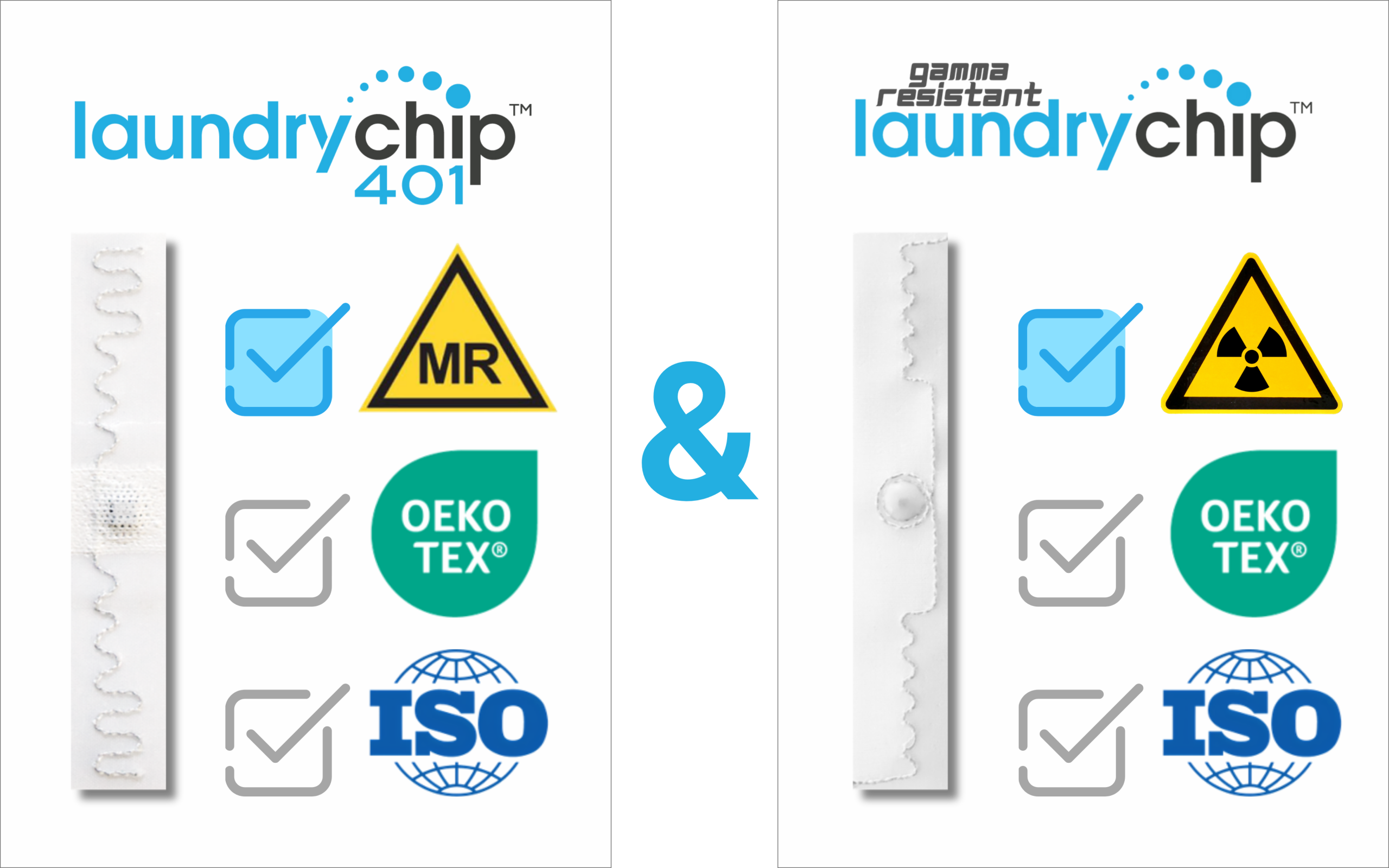
Datamars offers a healthcare-focused LaundryChips™ portfolio designed for the most critical clinical textile requirements: LaundryChip™ FT401 with MR Conditional certification for MRI environments, and Gamma Resistant LaundryChip™ FT501-GAM for workflows involving gamma ray sterilization.
COMPLIANCE & CERTIFICATIONS
Three LaundryChip™ certifications that matter in healthcare.
Healthcare textile environments impose requirements that standard RFID technology cannot meet. Datamars is the only manufacturer with a dedicated certified solution for each of the three critical healthcare requirements.
- MR conditional: the only RFID laundry tag certified safe for MRI environments. The LaundryChip™ FT401 is mri compatible RFID tag certified: MR conditional, tested and certified safe for use in all types of MRI systems. Linens and gowns tagged with the FT401 can pass through MRI suites without removal, without risk to patients and without disrupting clinical workflows. This is the only RFID laundry tag on the market with this certification. For hospitals and imaging centers, it is a non-negotiable requirement. No general-purpose RFID tag and no competitor without this specific certification can offer an equivalent solution. Read Datamars White Paper about LaundryChip™ FT401 MRI certification.
- Gamma Resistant LaundryChip™ FT501-GAM: the first UHF LaundryChip™ built to withstand gamma ray sterilization. Standard UHF RFID tags are not suitable for gamma ray sterilization workflows. Exposure to gamma radiation irreversibly damages conventional electronic components, making standard tags unusable in sterilization-critical applications such as gowns, masks, surgical drapes and medical dressings processed through gamma ray sterilization. The Gamma Resistant LaundryChip™ FT501-GAM overcomes this limitation with specialized semiconductor technology that ensures full immunity to gamma radiation. It supports over 100 gamma sterilization cycles without degradation. Built on the same proven mechanical platform as the rest of the LaundryChip™ family. ISO 18000-6C compliant. OEKO-TEX certified. Available in source-tagging (sewn) and in-pouch versions. This is the first and only UHF LaundryChip™ designed specifically for gamma ray sterilization workflows
- OEKO-TEX Standard 100: certified safe for direct skin contact. The entire LaundryChip™ 40x family is OEKO-TEX Standard 100 certified: tested and confirmed free of harmful substances and safe for direct skin contact. The relevant certification for patient gowns, garments worn against the skin and any textile in direct contact with patients, including vulnerable patients in clinical care.
SELECTION GUIDE
Different LaundryChips™ for different sterilization methods
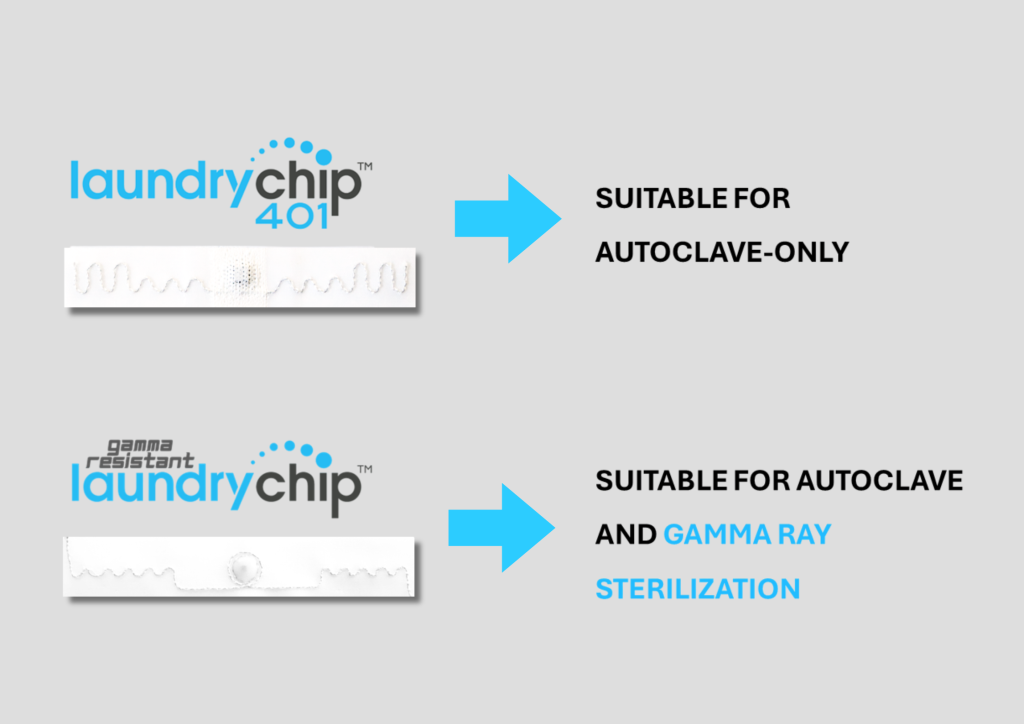
The right LaundryChip™ for healthcare depends on the sterilization method used in the textile workflow. Autoclave and thermal sterilization processes require a durable RFID tag that can withstand high-temperature washing, chemical agents and repeated processing. Gamma ray sterilization requires a dedicated gamma-resistant RFID tag engineered to survive radiation exposure. Matching the LaundryChip™ to the sterilization process is essential for reliable healthcare textile tracking:
-
Autoclave sterilization, no gamma exposure: the standard choice for rfid hospital linen and patient-facing garments processed through thermal sterilization is LaundryChip™ FT401.
-
Gamma ray sterilization: for healthcare textiles where gamma is part of the sterile supply chain (gowns, masks, medical dressings and reusable surgical textiles), choose Gamma Resistant LaundryChip™ FT501-GAM.
For the complete RFID garment tracking hospital tag range and selection guide, see RFID laundry tags.
SYSTEM OVERVIEW
Key components
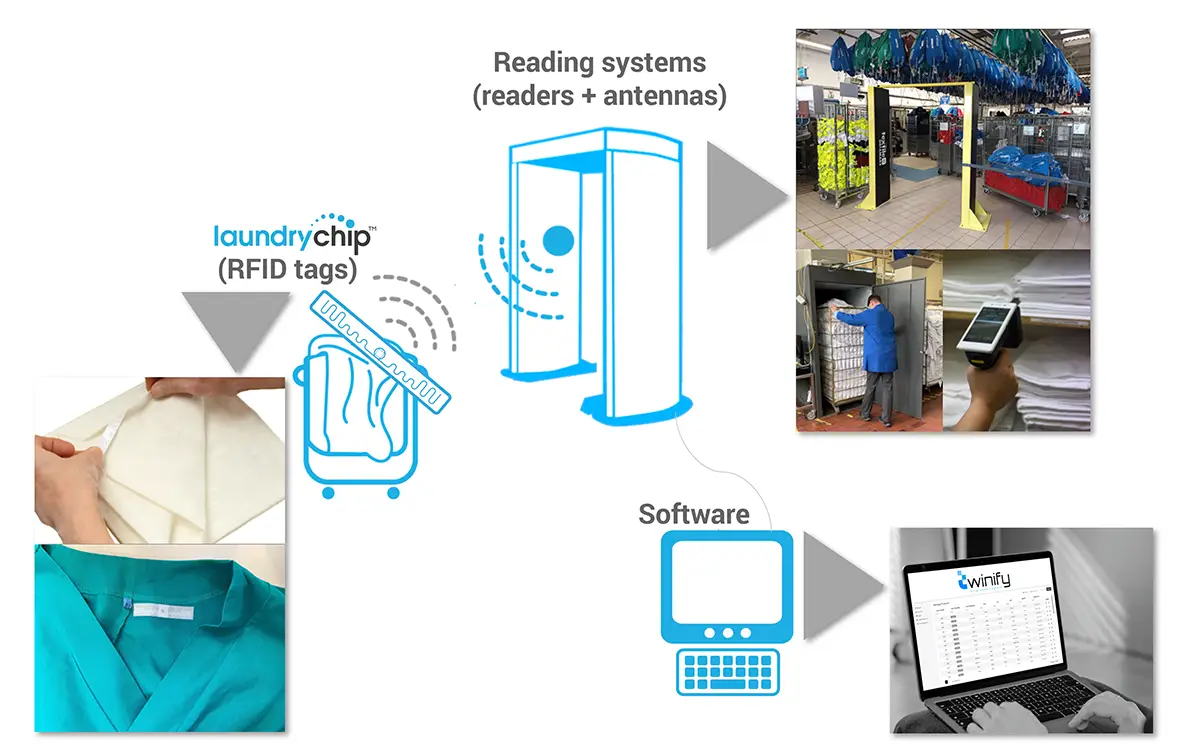
A complete healthcare linen and garment RFID tracking system combines three connected layers: RFID tags for healthcare textiles, RFID reading systems and software integration. The tag gives each healthcare textile a unique digital identity, the readers capture item movements automatically at clinical, laundry and distribution checkpoints, and the software turns every read into usable data for infection control, wash-count tracking, sterilization documentation, inventory visibility, loss reduction and audit reporting.
RFID tags for healthcare textiles
The LaundryChip™ FT401 (70 x 10 mm) is the standard tag for flat linen and patient-facing garments in autoclave sterilization workflows. MR conditional certified. The FT403 (37 x 15 mm) is for smaller items where hem space is limited. The Gamma Resistant LaundryChip™ FT501-GAM is for sterilization-critical applications involving gamma ray exposure. All tags withstand high-temperature industrial washing, chemical sterilization agents, water extraction, tumble drying and ironing across the full textile lifetime.
RFID reading systems
Purpose-built hardware captures textile movements automatically at defined process points in the healthcare linen cycle:
- Soiled linen collection points: readers embedded at smart chutes or collection areas log soiled items as they are deposited. Chain-of-custody records are created without manual handling of contaminated textiles.
- Laundry intake and dispatch portals: incoming and outgoing batches are verified at the laundry interface. Every discrepancy is flagged before textiles re-enter clinical circulation.
- Clean distribution points: cabinet systems or dispenser-integrated readers log clean textile issues per ward, per department or per employee. Up to 1,000 items read in 3 seconds.
- Handheld devices: for inventory counts, spot checks and reconciliation tasks at ward or storage level.
Software
Datamars provides two software layers that ensure the system runs reliably and that data reaches the right place. Storm monitors and manages all RFID devices across the installation. Cloudburst collects RFID read data and delivers it ready-to-use to third-party healthcare textile tracking management, EMR and ERP software. Datamars relies on a wide and proven network of tracking software partners for the operational management layer.
PROCESS FLOW
How healthcare linen and garment RFID tracking works
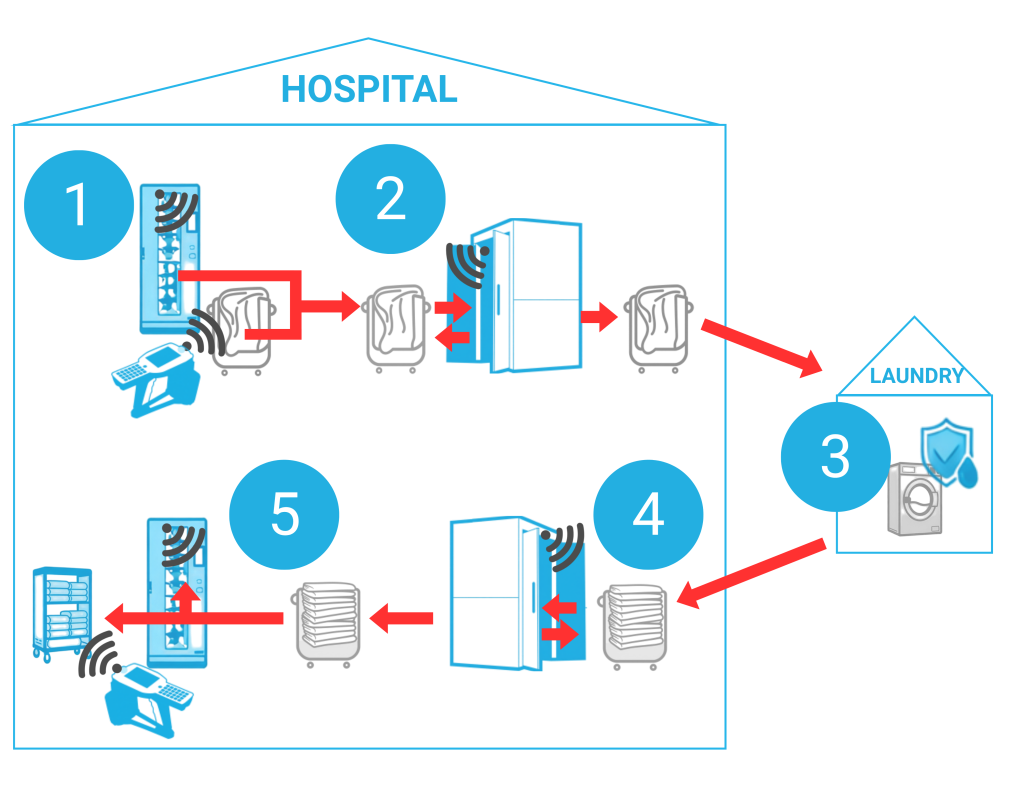
Healthcare RFID laundry tracking follows each textile through the full clinical textile cycle: soiled linen collection, dispatch to laundry, washing and decontamination, sterilization where required, return to the facility, clean distribution and audit reporting. At every stage, RFID readers capture item-level data automatically, reducing manual handling, documenting chain of custody and creating a reliable record of location, wash count, decontamination history, sterilization status and current availability.

Soiled linen collection
All used textiles are deposited at collection points. Readers log every item: identity, textile type, ward or department of origin. Chain-of-custody records are created automatically, with no manual handling of contaminated items required.

Dispatch to laundry
The soiled batch is verified before collection. Item count, textile type and attribution are confirmed. Discrepancies are flagged before the batch leaves the facility.

Wash and decontamination
Tags withstand the full decontamination process: high-temperature washing, chemical agents, sterilization cycles and, for the FT501-GAM, gamma ray sterilization. Wash count per item is updated after every cycle. Items that have completed the required number of hygiene cycles are flagged for review or replacement.

Return
Clean textiles return to the facility. Incoming delivery is verified at the receiving point.

Distribution
Items are distributed to wards, departments or through automatic dispensers. Clean textile issues are logged per location and per employee where rfid garment tracking hospital is required.
Audit and reporting
At any point, the system provides a complete audit trail per item: wash count, decontamination history, sterilization cycle count, location history and current status. Available on demand, without manual record-keeping.
OPERATIONAL GAINS
Key benefits
The main benefits of healthcare linen and garment RFID tracking are infection control support, automated wash-count tracking, reduced handling of soiled linen, cost control, supplier accountability, MRI compatibility and support for sterile textile management. By turning each healthcare textile into a traceable digital asset, RFID helps facilities reduce losses, document hygiene workflows, control inventory and manage textile lifecycle decisions with item-level data.

Infection control linen management
Automated wash count tracking healthcare textiles documents that every item has completed the correct decontamination protocol. Isolation gowns and surgical textiles are tracked individually. The audit trail is always available.
Controlling cost with no compromise on hygiene and patient security
Item-level lifecycle data eliminates premature replacement and reduces buffer stock. Purchase decisions are based on actual usage data. Linen losses are traced to specific points in the cycle.

RFID for sterile textile management
Documented wash and sterilization cycles for surgical textiles, isolation gowns and any textile used in sterile or controlled environments. Including gamma ray sterilization workflows with the FT501-GAM.

Reduced handling of soiled linen
Automated collection point reading reduces staff contact with contaminated textiles. A direct contribution to infection control linen management protocols.
Supplier accountability
Item-level records at the laundry interface eliminate disputes over delivery counts, lost items and sterilization cycle documentation.
MRI and gamma sterilization compatibility
The only RFID laundry tag portfolio that covers both MRI environments (FT401, MR conditional) and gamma ray sterilization workflows (FT501-GAM). No other supplier offers both certified solutions.
SUPPORTED TEXTILES
Healthcare textile types covered
Medical RFID tracking covers all reusable textile types used in clinical environments:
- Patient linen: bed sheets, pillowcases, duvet covers, blankets.
- Terry and hygiene items: towels, facecloths, bath sheets.
- Patient garments: gowns, pajamas, robes.
- Staff garments: scrubs, surgical gowns, lab coats, protective coveralls.
- Surgical and sterile textiles: drapes, covers and reusable surgical items processed through autoclave or gamma ray sterilization workflows.
- Flat linen in food and nutrition services: table linen and napkins used within the facility. See RFID flat linen tracking [/rfid-flat-linen-tracking/].
For the full portfolio of solutions by sector, role and textile type, see our RFID solutions specialized for any laundry sector and textile. For the broader context of RFID tracking technology across the full textile lifecycle, see RFID textile tracking.
CASE STUDY
How Einstein Hospital cut linen loss by 80% and saved $300,000 a year
Einstein Hospital in São Paulo, one of Latin America’s leading healthcare institutions, was processing 10 tons of laundry daily across 150 storage areas, all checked manually four times a day by 33 staff members. Linen loss was running at 4% of inventory. After tagging 158,000 items with LaundryChip™ FT401, inventory time dropped 86%, linen loss fell from 4% to 0.8% and total annual savings reached $300,000. Manual counting was replaced by real-time, item-level visibility across the entire textile flow.
QUESTIONS & ANSWERS
Frequently asked questions
Healthcare linen tracking with RFID uses washable UHF RFID tags embedded in reusable healthcare textiles to automatically identify and monitor patient linen, staff garments, surgical textiles and isolation gowns throughout the healthcare laundry cycle. Each item carries a LaundryChip™ with a unique digital identity. RFID readers capture movements automatically at soiled collection, laundry dispatch, wash and decontamination, clean return, ward distribution and staff issue points. The system creates a continuous audit trail of location, wash count, decontamination history, textile type and current status, without manual counting or paper-based record-keeping.
RFID tags for hospitals and MRI environments must meet specific safety and certification requirements. The LaundryChip™ FT401 is MR Conditional certified, meaning it is certified for use in MRI environments under the defined MR Conditional conditions. This is critical for patient linen, gowns and garments that may enter imaging areas without being removed from circulation. The LaundryChip™ 40x family is also OEKO-TEX Standard 100 certified, confirming that the tags are free from harmful substances and suitable for direct skin contact. These certifications are especially relevant for patient-facing textiles and clinical workflows.
The Gamma Resistant LaundryChip™ FT501-GAM is a UHF LaundryChip™ engineered specifically for healthcare workflows involving gamma ray sterilization. Standard RFID tags are not suitable for gamma sterilization because radiation can damage conventional electronic components and make the tag unreadable. The FT501-GAM uses specialized semiconductor technology designed to remain functional after repeated gamma exposure, supporting over 100 gamma sterilization cycles. It is needed for textiles such as gowns, masks, medical dressings, surgical drapes and reusable sterile textiles when gamma ray sterilization is part of the sterile supply chain.
RFID supports infection control in linen management by documenting the wash count, decontamination history and movement of each healthcare textile item automatically. When patient linen, isolation gowns or surgical textiles move through the healthcare laundry cycle, RFID readers record each item at collection, laundry intake, washing, sterilization where required, return and clean distribution. This creates a reliable chain-of-custody record without manual handling of contaminated textiles. The system can verify whether each item has completed the required wash or decontamination protocol before re-issue, giving healthcare teams access to audit-ready hygiene data at item level. See our video.
RFID can track individual garments in hospitals by assigning each patient gown, scrub, lab coat, surgical gown or protective coverall a unique LaundryChip™ identity. RFID readers capture issue, return, wash cycle, department movement and end-of-life status automatically, without manual scanning and without line-of-sight. This makes RFID garment tracking in hospitals useful for staff garments, patient-facing textiles, PPE and controlled clinical garments. Where required, garments can be linked to departments, wards, employees or distribution points, giving hospitals better control over availability, hygiene history, wash count, losses and replacement planning.
The difference between the LaundryChip™ FT401 and the Gamma Resistant LaundryChip™ FT501-GAM depends on the sterilization workflow. The FT401 is the standard RFID hospital linen tag for autoclave and thermal sterilization workflows where gamma ray sterilization is not part of the process. It is MR Conditional certified and OEKO-TEX Standard 100 certified, making it suitable for many patient-facing healthcare textiles. The FT501-GAM is designed for gamma ray sterilization workflows and uses specialized semiconductor technology to withstand repeated radiation exposure. The correct choice depends on whether the textile will be exposed to gamma sterilization.
RFID tags for healthcare textiles must withstand demanding laundry and sterilization conditions, including industrial detergents, bleach, chemical sterilization agents, high-temperature washing, water extraction, drying and ironing. LaundryChips™ are engineered for these conditions and are designed to remain attached and readable throughout the textile lifetime when the correct tag variant and application method are used. For autoclave and thermal sterilization workflows, the LaundryChip™ FT401 is the standard choice. For gamma ray sterilization workflows, the Gamma Resistant LaundryChip™ FT501-GAM is the dedicated solution.
RFID reduces costs in healthcare linen management by replacing manual inventory and estimated stock control with item-level visibility. Each textile is identified automatically, making it possible to track losses, reduce buffer stock, verify laundry deliveries, document wash counts and base purchasing decisions on actual lifecycle data. Healthcare facilities can see where linen and garments are lost, which items are overused, which textiles should be replaced and where inventory is sitting unused. This supports controlling cost with no compromise on hygiene and patient safety, because the same system provides both operational visibility and documented textile history.
The difference between healthcare linen tracking and RFID laundry tracking is mainly the level of clinical requirement. RFID laundry tracking covers the laundry process itself: intake, washing, finishing, dispatch, return and wash-count recording. Healthcare linen tracking applies the same RFID infrastructure to clinical textile workflows, where hygiene, infection control, sterilization documentation, patient-facing textiles, MRI compatibility and audit trails may be required. In healthcare environments, the laundry cycle is only one part of the broader compliance and patient safety context. The two layers work together within the same RFID system.
RFID healthcare linen tracking can integrate with hospital management, EMR, ERP, laundry management or third-party textile tracking software through the right data architecture. Datamars provides Cloudburst as a data integration layer that collects RFID read data and delivers it ready-to-use to external software systems. Storm monitors and manages the RFID device infrastructure across the installation. This allows healthcare facilities and laundry providers to connect item-level textile data with operational platforms used for inventory, billing, reporting, compliance or supplier management. For the full integration architecture, see RFID laundry management system.
RFID healthcare linen tracking is suitable for textile rental operations serving hospitals because it gives both the healthcare facility and the supplier a shared, item-level record of textile movement, wash cycles, deliveries, returns, losses and sterilization documentation. Many hospitals outsource linen and garments to commercial laundries or textile rental providers, making handover points a common source of disputes and missing items. RFID supports accurate billing, loss attribution, inventory control and lifecycle management across the full rental cycle, including clinical textile requirements. For rental-specific workflows, see RFID textile rental tracking.
The same RFID healthcare textile tracking system can track patient linen, flat linen, staff garments, scrubs, gowns, lab coats and other reusable healthcare textiles when the right LaundryChip™ format is selected for each item. All tagged textiles can run on the same RFID infrastructure, with software assigning each item to a textile type, ward, department, employee or workflow. This allows hospitals and healthcare laundries to manage linen availability, garment issue, wash counts, losses and decontamination history in one system. For workwear and uniform tracking in non-clinical environments, see workwear and uniform tracking.
Healthcare textile RFID tracking is one application within the broader field of RFID textile tracking, which follows reusable textiles across their full lifecycle: production, service, washing, maintenance, end-of-life and recycling. In healthcare, the focus is on hygiene, infection control, sterilization documentation, patient safety and clinical textile availability. The same RFID infrastructure can also support other textile environments, such as hospitality, textile rental, flat linen and workwear programs. For hotel and hospitality linen operations, see hotel linen tracking.
GET STARTED
Ready to improve textile control across your facility?
Tell us about your operation: facility type, textile volumes, laundry structure (in-house or external) and any specific compliance requirements including MRI environments or gamma ray sterilization workflows. We will recommend the right healthcare RFIDlaundry configuration for your needs.
 Datamars | Textile ID