

RFID Laundry Tracking
Full visibility and control over every textile item, at every stage of the process.
RFID laundry tracking allows laundries to identify, count and monitor garments, linen and reusable textiles automatically throughout the entire laundry process. Each textile item carries a durable RFID tag with a unique digital identity. When the item passes through an RFID reading point, the system captures its data automatically, without manual scanning and without line-of-sight.
This gives laundries real-time visibility over what has entered the laundry, where each item is in the process, which customer it belongs to, how many times it has been washed, what is missing and which textiles are approaching end of life.
The result is accurate inventory data, reliable wash-count records and full operational control, without manual counting. For workwear and uniform programs, RFID laundry tracking also supports correct garment assignment, automated dispensing and reliable garment availability.
The result: real-time traceability and inventory data, accurate wash count records and full operational visibility, without manual counting. For workwear programs, this also means correct garment assignment, automated dispensing and reliable garment availability.
SYSTEM OVERVIEW
Key components
A complete RFID laundry tracking system is made of three connected core elements: RFID tags, RFID reading systems and software integration. The tag gives each textile item a unique digital identity, the reading systems capture that identity automatically at key process points, and the software turns each read into usable data for inventory control, wash-count records, billing, reporting and process visibility.
RFID laundry tags
A tiny durable RFID transponder, the LaundryChip™, is permanently embedded in each textile item. It survives high-temperature washing, chemical detergents, tumble drying, ironing and pressing for the full lifetime of the textile. Tags are OEKO-TEX Standard 100 certified and available in two main formats: FT401 (70 × 10 mm) and FT403 (37 × 15 mm, for smaller items like napkins). The FT401 is also MR conditional certified, safe for MRI environments.
RFID reading systems
Purpose-built hardware capture tag data automatically at selected points in the process, without manual scanning and without line-of-sight. Options include cabinets (up to 1,000 items in 3 seconds), pass-through portals, tunnel systems integrated into sorting and finishing lines, handheld devices and combo systems (UHF-HF-LF) for transitioning from older technologies.
Software
Tags and readers capture the data. Two Datamars software solutions ensure the system runs reliably and that data reaches the right place. Storm monitors and manages all RFID devices across the installation, keeping the reading infrastructure reliable and under control. Cloudburst acts as a plug-and-play data layer: it collects RFID read data and delivers it ready-to-use to third-party textile tracking software (Datamars relies on a wide and proven network of tracking software partners). From there, data connects seamlessly to the laundry’s own management system, ERP, billing and lifecycle reporting workflows.
STEP BY STEP
How RFID tracking works
RFID laundry tracking works by identifying each tagged textile item automatically as it moves through the laundry cycle. At each key stage — collection, check-in, washing, finishing, dispatch, delivery and return — RFID readers capture item-level data and update the textile’s status, location, customer allocation and wash count. This creates a live digital record of every item without manual counting or line-of-sight scanning.

Collection and check-in
Soiled items arrive at the laundry. A pass-through portal or reading point captures the incoming batch automatically: what arrived, from which customer and in what quantity. No manual counting. No need to unpack and check every item one by one.

Washing and finishing
Items move through the wash and finishing cycle. RFID tags remain attached to the textile, withstand every step and allow each item to be identified again after washing, drying, ironing or folding. After finishing, a reading point confirms processing and updates the wash count for each individual item.

Check-out and dispatch
A final scan verifies the outgoing batch: correct items, correct quantities, correct client allocation. Discrepancies are flagged before the truck leaves.

Delivery and return
At the client site, reading points confirm delivery and track returns, closing the loop on the full textile cycle.
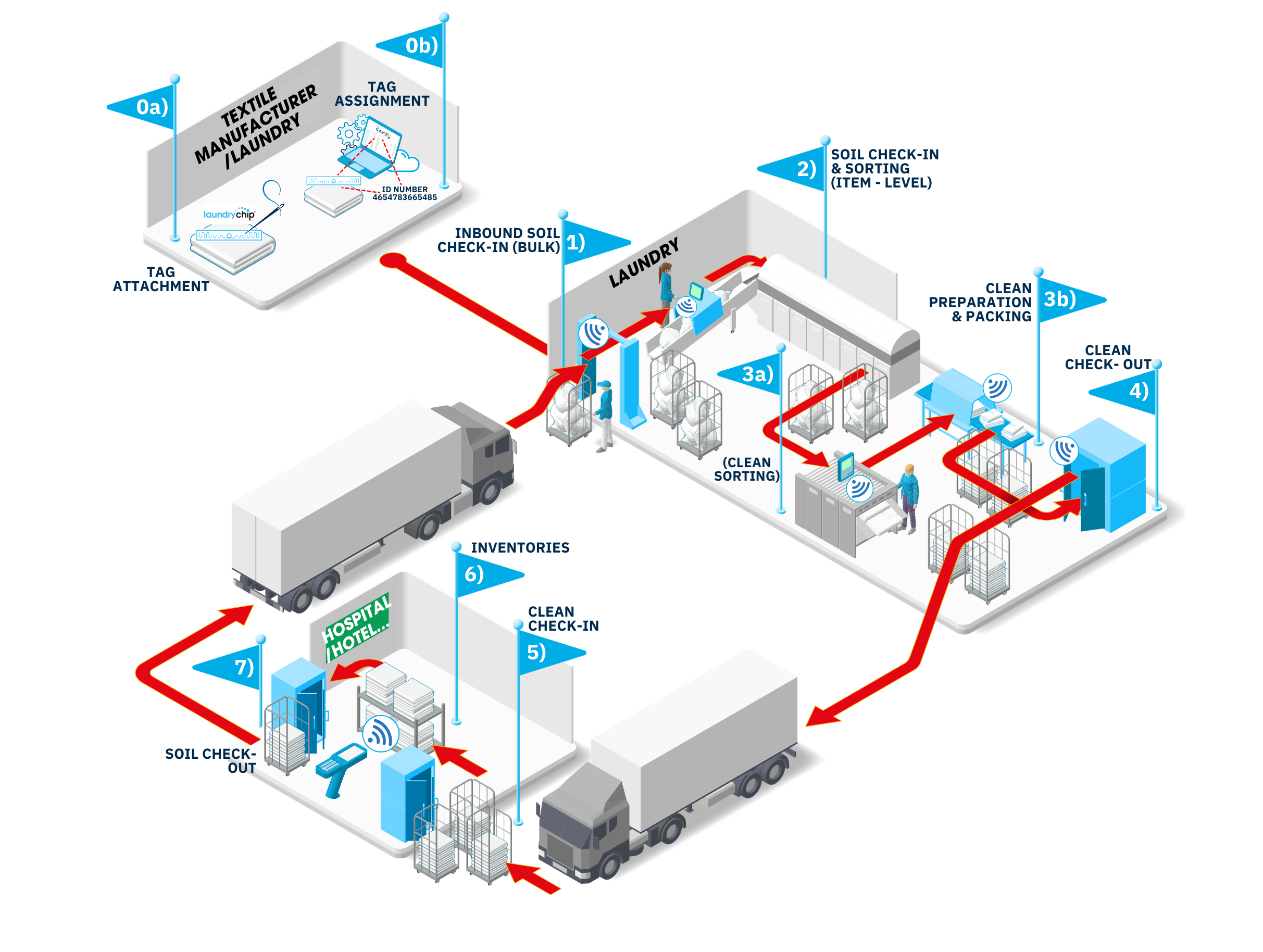
At every stage, operators see live inventory, item movement and wash count data on a single dashboard. For more background on why RFID is used in laundry operations, see Why use RFID in the laundry sector.
OPERATIONAL IMPACT
Key benefits
The main benefits of RFID laundry tracking are automated counting, real-time inventory visibility, fewer textile losses, accurate wash-count data, more reliable client billing and better replacement planning. By turning every textile item into a traceable asset, RFID helps laundries reduce manual work, improve operational control and make decisions based on live item-level data.

Automated counting
Up to 1,000 items in 3 seconds, no manual handling required.

Real-time inventory visibility
Always know what is in the laundry, at the customer site, in transit or missing.

Fewer textile losses
Track every item, pinpoint exactly where losses happen.
Accurate wash count per item
Replace textiles at the right time, not too early (cost), not too late (quality risk).

Reliable client billing
Item-level data reduces disputes and improves customer transparency.
Lower labour costs
Automate counting, reconciliation and inventory checks, so staff can focus on higher-value operational tasks.
Better replacement planning
Purchase based on actual lifecycle data, not estimates.
WHO USES IT
Common applications
RFID laundry tracking is used in any operation where reusable textiles are washed, distributed, returned and reused at scale. It is especially valuable for industrial laundries, textile rental companies, hotels, healthcare facilities, workwear programs and senior care environments, where item-level visibility helps reduce losses, improve availability, support billing accuracy and control the full textile flow.
Industrial laundries and textile rental companies.
High-volume, multi-client operations where billing accuracy and loss prevention are critical.

Hospitals and healthcare.
Bed linen, towels, tablecloths, napkins and staff uniforms. Focus on linen loss reduction and inventory accuracy.
Hotels and hospitality.
Bed linen, towels, tablecloths, napkins and staff uniforms. Focus on linen loss reduction and inventory accuracy.

Senior care.
Bed linen, towels, tablecloths, napkins and staff uniforms. Focus on linen loss reduction and inventory accuracy.

Workwear and uniform programs.
Manufacturing, food processing, utilities. Automated sorting, dispenser integration, PPE traceability.
The full portfolio of solutions by sector and textile type is available in Our Solutions.
QUESTIONS & ANSWERS
Frequently asked questions
RFID works in commercial laundry by giving each textile item a unique digital identity through a durable LaundryChip embedded in the textile. As garments, linen or other reusable textiles move through the laundry process, RFID readers capture each tag automatically at key reading points, without manual scanning and without line-of-sight. The read data flows into Cloudburst, where it becomes usable information for inventory visibility, process control, wash-count tracking and third-party textile tracking software. This allows laundries to know what has been received, processed, dispatched, returned or identified as missing. The full range of transponders is covered in RFID laundry tags.
RFID tags for industrial washing are designed to survive the demanding conditions of commercial and industrial laundry operations. Datamars LaundryChips are permanently embedded in textile items and withstand high-temperature washing, chemical detergents, extraction, tumble drying, ironing and pressing. They are built to remain attached and readable throughout the full lifetime of the textile, supporting reliable item identification even after repeated wash cycles. This durability is essential because RFID laundry tracking depends on each textile keeping the same unique digital identity from first use through end of life, without requiring manual relabelling or frequent tag replacement.
UHF RFID is the standard technology for textile services because it enables fast, automatic bulk reading of many textile items at the same time, over longer distances and without line-of-sight. In laundry and textile rental operations, this means bags, trolleys, stacks or batches of tagged textiles can be identified without handling each item individually. UHF RFID makes high-throughput laundry tracking operationally viable by reducing manual counting, speeding up check-in and dispatch, and improving inventory accuracy across large volumes of linen, garments and reusable textiles. See UHF RFID for textile services.
RFID supports real-time traceability in linen management by recording when and where each tagged linen item is read throughout the laundry and distribution cycle. This makes it possible to know which customer an item belongs to, whether it is in the laundry, in transit, at the customer site or missing, and how many times it has been washed. Real-time RFID traceability helps laundries and linen managers improve inventory accuracy, reduce losses, plan replacements and verify deliveries and returns with item-level data instead of estimates or manual counts. See RFID flat linen tracking.
RFID laundry tracking supports hotels and hospitality laundries by providing item-level visibility over bed linen, towels, table linen, robes, staff uniforms and other reusable textile assets. In hospitality environments, RFID helps monitor what has been delivered, returned, washed, dispatched or lost, making linen inventories more accurate and reducing replacement costs. For hotel groups, resorts and outsourced laundry providers, RFID also improves transparency between the hotel and the laundry by creating reliable data on textile movement, availability and wash counts. This supports better stock control, fewer linen shortages and more accurate service reporting. See hotel linen tracking.
RFID can be used for healthcare linen and garments to improve traceability, availability and control over patient linen, surgical textiles, staff garments and other reusable healthcare textiles. In hospitals and healthcare laundries, item-level RFID data helps track textile movement, monitor wash counts, reduce losses and support hygiene and infection-control workflows. RFID also helps ensure that the right garments and linen are available when needed, while giving laundry operators and healthcare facilities better visibility over stock levels, returns and lifecycle data. Specific product choices are important in healthcare environments, including MRI-related requirements. See healthcare linen and garment tracking.
RFID supports workwear and uniform programs by linking each garment to a specific wearer, department, customer or service process. This makes it possible to track garment assignment, availability, wash history, repairs, replacements and returns across the full workwear cycle. In industries such as manufacturing, food processing, utilities and other professional environments, RFID improves control over uniforms and PPE by reducing losses, automating sorting and enabling integration with garment dispensers or return systems. For laundries and textile service providers, RFID workwear tracking also supports more accurate billing, better stock planning and reliable garment availability for end users. See workwear and uniform tracking.
RFID is useful for textile rental operations because it gives rental companies item-level visibility over textiles that are constantly moving between the laundry, customers, transport and storage. In textile rental, RFID helps identify which items belong to which customer, how many items are in circulation, how many have been delivered or returned, which are missing and how many wash cycles each item has completed. This data supports more accurate billing, fewer disputes, better inventory control and more reliable replacement planning. For high-volume rental operations, RFID also reduces manual counting and improves operational efficiency across multi-customer workflows. See RFID textile rental tracking.
Datamars does not provide the full tracking software or laundry management system used to manage all operational workflows in a laundry. Datamars provides the RFID infrastructure that enables reliable textile identification and data capture: durable LaundryChip transponders, RFID reading systems and software integration layers such as Cloudburst and Storm. Cloudburst collects RFID read data and makes it ready to use in third-party textile tracking software, while Storm monitors and manages RFID devices across the installation. For complete laundry management functionality, Datamars works with a wide and proven network of tracking software partners.
The difference between RFID laundry tracking and an RFID laundry management system is that RFID laundry tracking is one functional component within a broader operational platform. RFID laundry tracking covers item identification, automated reading, location visibility, wash-count data and textile movement across the laundry process. An RFID laundry management system uses this tracking data as part of a wider system that may also manage inventory control, customer workflows, supplier processes, production planning, reporting, billing, ERP integration and other laundry operations. In simple terms, RFID tracking provides the item-level data; the management system uses that data to run the broader laundry workflow.
RFID laundry tracking is suitable for smaller operations when the laundry needs better control over textile inventory, losses, wash counts or customer allocation. The value of RFID is not limited to very large industrial laundries: smaller operations can also benefit from automated counting, fewer manual checks, more accurate inventory data and improved visibility over textile movement. The right RFID setup depends on the scale, textile types, process complexity and operational goals of the laundry. A smaller operation may start with selected reading points or specific textile categories, then expand the system as volumes, requirements or customer needs grow.
The difference between RFID laundry tracking and RFID textile tracking is mainly the scope of visibility. RFID laundry tracking focuses specifically on the movement of textile items through the laundry process: collection, check-in, washing, finishing, dispatch, delivery and return. RFID textile tracking is broader: it follows reusable textiles across their entire lifecycle, from production and first use through active service, maintenance, end of life and recycling. The laundry process is one important stage within that wider lifecycle. Twinify is the Datamars software platform designed for full textile lifecycle visibility across all these stages.
GET STARTED
Need help getting started?
Contact us and tell us about your laundry operation. We will help you understand which RFID setup best fits your process, textile types and operational goals.
 Datamars | Textile ID