

RFID workwear and uniform tracking
Make sure every operator gets the right workwear, on time, every time.
RFID workwear and uniform tracking allows companies, laundries and textile rental providers to identify, assign and monitor every garment automatically throughout the full workwear cycle. Each uniform, PPE item or workwear garment carries a washable RFID garment tag — the LaundryChip™ — with a unique digital identity permanently embedded in the textile.
Large workwear programs often manage hundreds or thousands of garments across multiple employees, departments, shifts, sites and laundry partners. Without RFID, garments go missing, returns are incomplete, sorting errors happen, wash counts are estimated, PPE compliance is difficult to document and operators may not receive the right garment when they need it.
With RFID uniform tracking, every movement is captured automatically: garment issue, return, laundry intake, wash cycle, sorting, redistribution, reassignment and end-of-life. The system shows where every garment is, who it is assigned to, how many times it has been washed, whether it has been returned and whether it is ready for the next shift.
The result is a more reliable workwear operation: correct garment availability, item-level employee assignment, accurate wash-count records, PPE compliance documentation, loss reduction and fewer disputes with laundry partners.
SYSTEM OVERVIEW
Key components
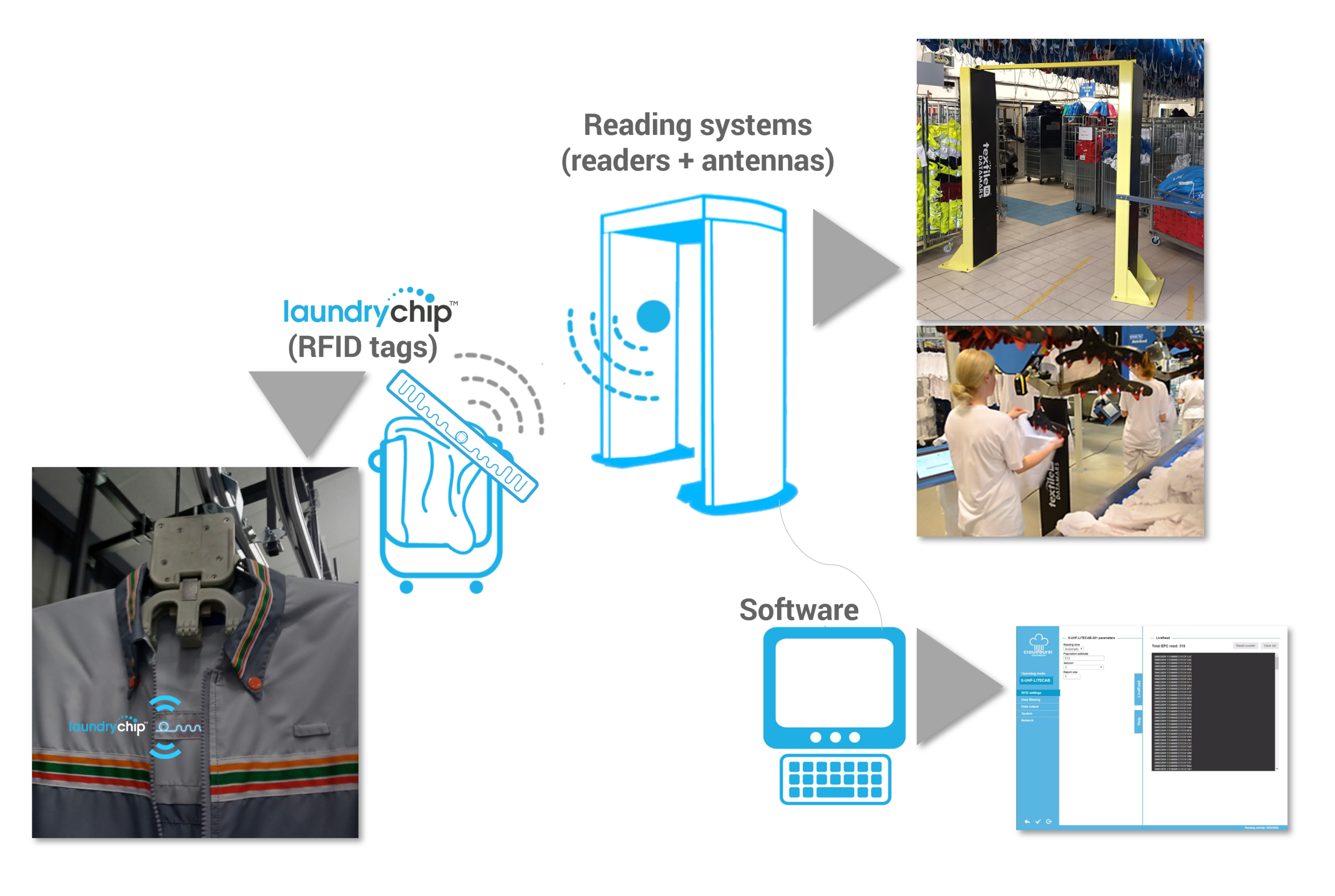
A complete RFID workwear and uniform tracking system combines three connected layers: RFID tags for garments, RFID reading systems and software integration. The tag gives each garment a unique digital identity, the reading systems capture garment movements automatically at issue, return, laundry and sorting points, and the software turns every read into usable data for employee assignment, inventory visibility, wash-count tracking, PPE compliance, loss control, billing and lifecycle management.

RFID tags for garments
The LaundryChip™ FT401 is the standard RFID garment tag for workwear and uniforms. At 70 x 10 mm it fits in the hem, collar or waistband seam, invisible once embedded. The FT403 (37 x 15 mm) is the format for smaller items such as gloves, caps, scarves, sleeve protectors and other compact garments. Both withstand industrial washing, chemical detergents, tumble drying and mechanical pressing for a minimum of 200 wash cycles. Both are available as source tagging (sewn in during manufacturing), patchable (heat-sealed directly onto the fabric) or in-pouch (sewable pouch for retrofitting existing inventory). Both are also available with integrated QR code or Datamatrix code for smartphone reading at the point of issue or return. The LaundryChip™ 40x and 50x families are OEKO-TEX Standard 100 certified, safe for direct skin contact.

RFID reading systems
Purpose-built hardware captures garment movements automatically at defined process points:
- UHF Read on the Fly (RoF) reading systems: powered by advanced software algorithms, read and sort hanging garments with exceptional precision, even with high-speed conveyors. Discover more.
- Fixed portals at issue and return stations: read garments automatically as they pass through, recording the transaction without manual scanning.
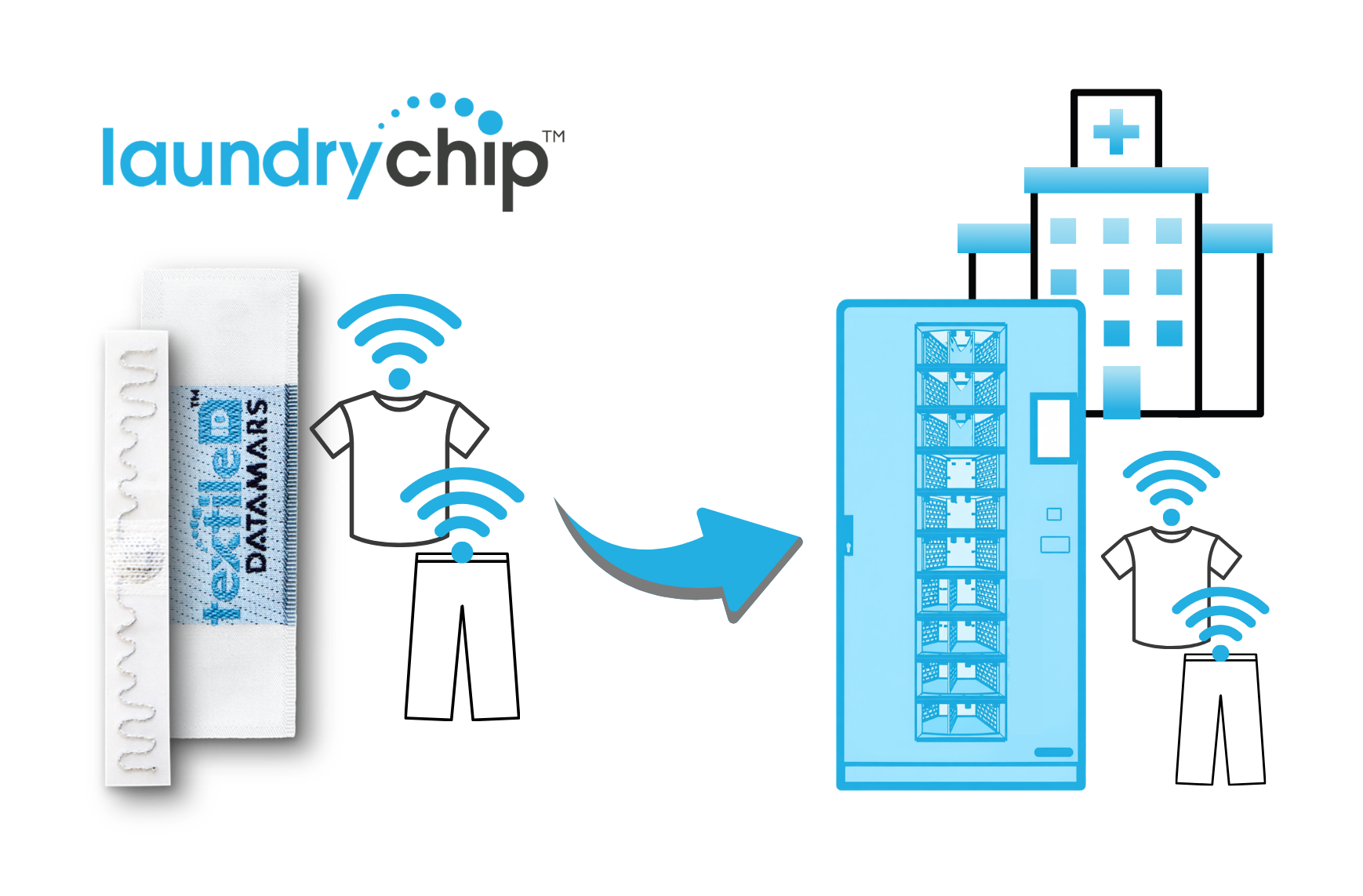
- Automated dispenser integration: RFID readers integrated with dispensing units capture garment issue per employee, per size, per garment type. The system assigns the issued item to the employee and updates inventory in real time. Datamars partners with leading automated dispenser manufacturers to deliver fully integrated solutions.
- Hanging conveyor antennas: UHF antennas positioned along the conveyor line identify tagged garments in transit through a homogeneous reading area, ensuring consistent detection at full line speed.
- Handheld devices: for inventory counts, spot checks and reconciliation tasks at the laundry or on the floor.
- Cabinet systems: bulk counting at transfer points, up to 1,000 items in 3 seconds.

Software
Datamars provides two software layers that ensure the system runs reliably and that data reaches the right place. Storm monitors and manages all RFID devices across the installation. Cloudburst collects RFID read data and delivers it ready-to-use to third-party workwear management software. Datamars relies on a wide and proven network of tracking software partners for the operational management layer.
PROCESS FLOW
How RFID uniform tracking works in practice
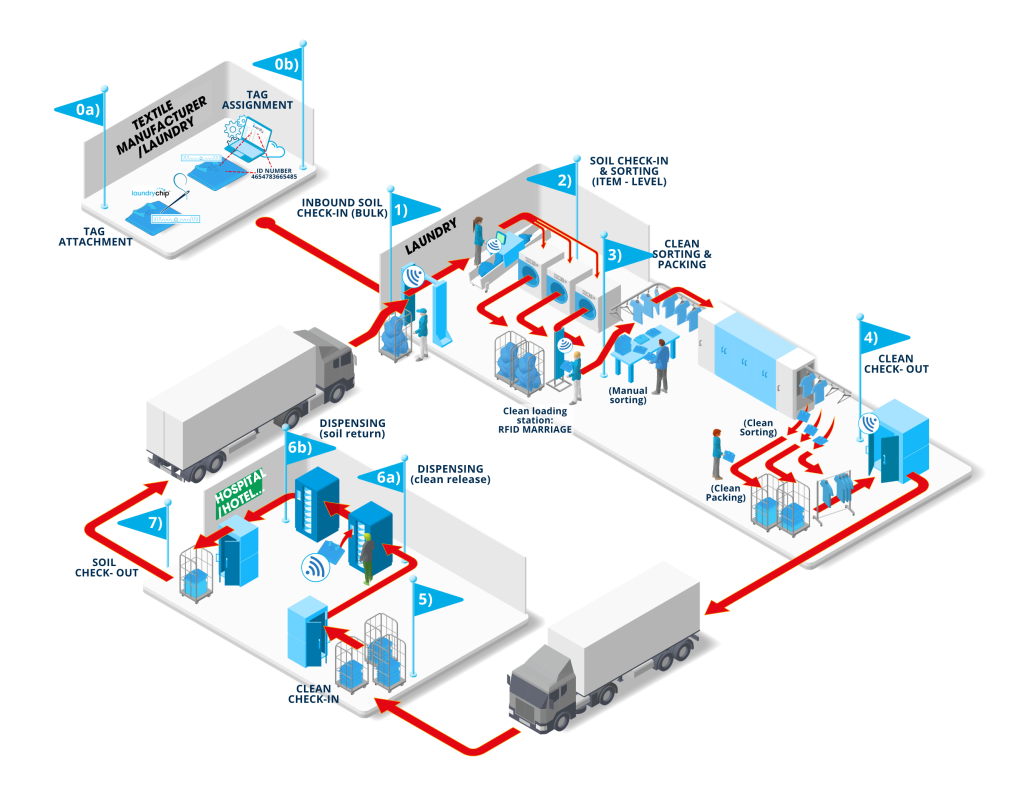
RFID uniform tracking follows each garment through the full workwear cycle: garment registration, issue to operator, return, laundry processing, automated sorting, redistribution and replacement. At every stage, RFID readers capture item-level data automatically, without manual scanning and without line-of-sight. This creates a live record of which garment belongs to which employee, where it is, when it was returned, how many times it has been washed and whether it is still suitable for use.

Garment entry and registration
New garments enter the system at source (tagged during manufacturing) or at the laundry or depot. Each item is assigned a unique identity. Employee size profile, garment type and department are linked to the item record in the management software.

Issue to operator
The operator collects their workwear from a dispenser or issue point. An RFID reader captures the transaction automatically: which garment, which size, which employee, at what time. No manual logging. No signature required.

Return and collection
The operator returns soiled garments to a return unit or collection point. The RFID reader logs the return: item identity, condition flag if applicable, employee attribution. Items not returned on schedule are flagged as outstanding.

Laundry cycle
Garments are dispatched to the laundry in a verified batch. At the laundry, intake and dispatch reading points track the garment through the wash cycle. Wash count is updated per item after every cycle. LaundryChips™ handle the most demanding wash conditions. For PPE and protective workwear, each wash cycle is documented: wash count data provides proof of compliance with hygiene and safety standards. Items approaching end of certified service life are automatically flagged before they reach an operator.

Automated sorting and redistribution
Clean garments are loaded onto automated hanging conveyor systems. RFID identification at the clean upload point enables automatic sorting by client, order, department and size, without manual intervention. The right garments are routed to the right destination before they leave the laundry. Discover more about Datamars UHF Read on the Fly (RoF) reading system.

Redistribution to dispenser or depot
Sorted garments return to the customer site. The system allocates items by size and availability for the next issue cycle. Dispensers are restocked. Items that have reached their wash count threshold are flagged for replacement and removed from circulation.
OPERATIONAL GAINS
Key benefits
The main benefits of RFID workwear tracking are correct garment availability, item-level assignment per employee, full wash cycle traceability, PPE compliance documentation, loss reduction, inventory accuracy and billing transparency. By turning every garment into a traceable digital asset, RFID helps workwear programs reduce manual administration, prevent shortages at shift start, document garment history and make replacement decisions based on real lifecycle data.
Right garment, right person, right time
Automated dispensing integrated with RFID ensures every operator receives the correct garment, correct size and correct type at the point of need. No sorting errors, no shortages at shift start.

Full wash cycle traceability
Every garment is tracked through the complete laundry cycle: intake, washing, finishing, dispatch and return. Wash count per item, client attribution and delivery verification are all captured automatically. This is what RFID workwear tracking delivers across industrial laundry operations.

Item-level assignment per employee
The system records which garment belongs to which person, how many items each employee has in circulation and when they were last returned. RFID tracking of employee uniforms creates a clear, auditable record of every assignment and every movement.

PPE compliance documentation
Documented wash count per item supports compliance with safety and hygiene regulations in healthcare, food processing, pharmaceutical and industrial environments. RFID removes manual record-keeping from the compliance process.

Loss reduction
RFID work clothes tracking identifies exactly where garments go missing in the cycle and which employee accounts show persistent non-returns.

Inventory and billing accuracy
Real-time stock visibility per size, per garment type, per department. Purchasing decisions based on actual lifecycle data, not estimates. Item-level data shared between operation and laundry partner eliminates disputes over garment counts and wash cycles.
DEPLOYMENT SCENARIOS
Common applications
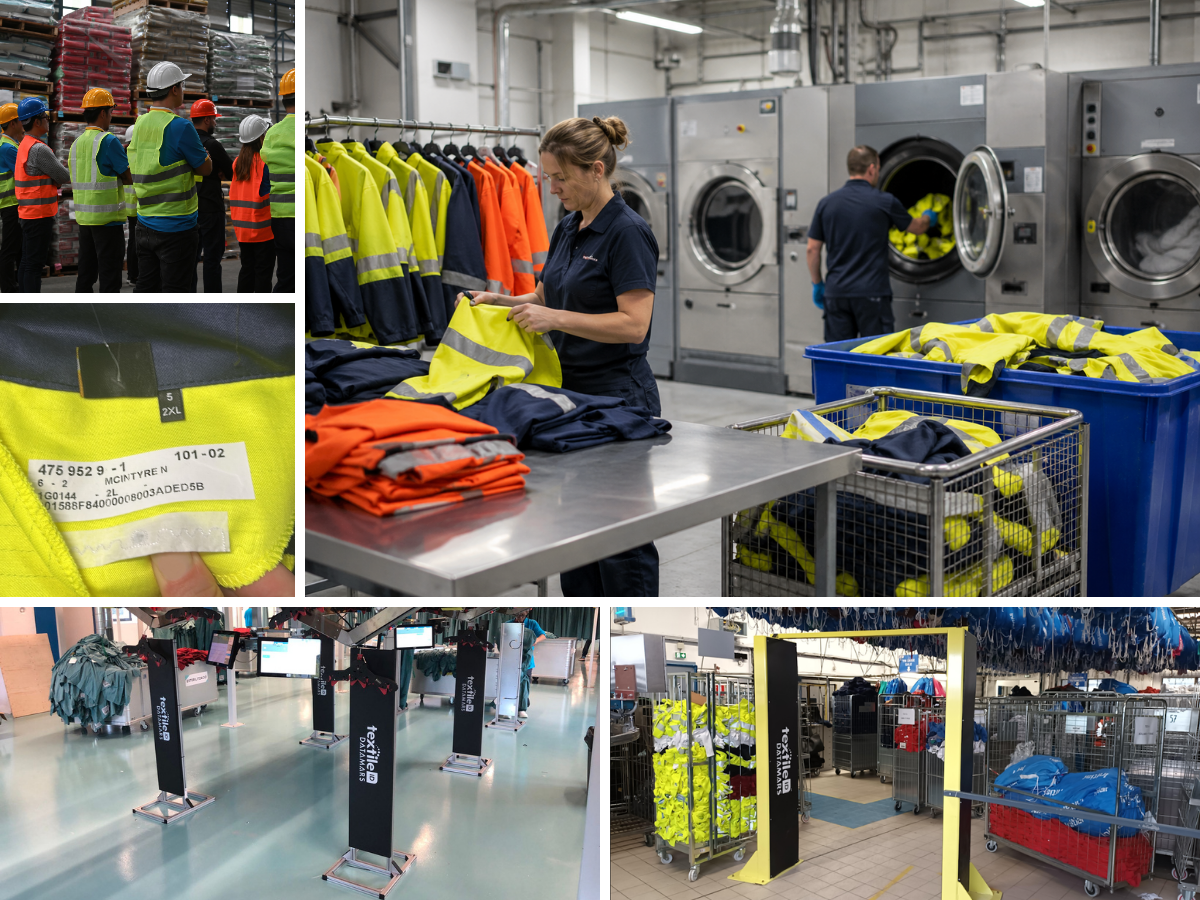
RFID workwear tracking is used across industries where garment availability, hygiene compliance and PPE accountability are operational requirements:
- Manufacturing and industrial. High volumes of workwear and PPE for production floor operators. Focus on garment availability per shift, PPE wash count compliance and loss reduction.
- Food processing. Strict hygiene protocols. RFID documents that each garment has completed the correct wash cycle before re-issue. Supports audit-ready compliance records.
- Pharmaceutical and cleanroom. Garments require certified wash cycles and controlled re-issue. RFID automates the compliance documentation process.
- Healthcare. Scrubs, gowns and staff garments. Hygiene traceability, wash count per item, MRI-safe tagging where required. See healthcare linen and garment tracking.
- Logistics and utilities. High-visibility workwear and technical garments for field operators. Automated tracking across depot, laundry and field assignment.
- Hospitality. Staff uniforms across housekeeping, F&B and front-of-house. Garment availability per shift, loss tracking and laundry reconciliation. See hotel linen tracking.
- Textile rental for workwear. Rental operations tracking garments per client contract, per employee, per wash cycle. See RFID textile rental tracking.
For the full portfolio of solutions by sector, role and textile type, see our RFID solutions specialized for any laundry sector and textile. For the broader context of RFID linen tracking technology across the full textile lifecycle, see RFID textile tracking.
PARTNER SOLUTIONS
Automated workwear dispensing
RFID LaundryChips™ do more than track & identify textiles: they also power automated garment dispensing
and intelligent stock management. See some video examples from our technology partners:
QUESTIONS & ANSWERS
Frequently asked questions
RFID workwear tracking is the use of washable UHF RFID tags embedded in garments to identify, assign and monitor workwear automatically throughout its operational lifecycle. Each uniform, PPE item or workwear garment carries a LaundryChip™ with a unique digital identity. RFID readers capture garment movements automatically at issue points, return units, laundry checkpoints, sorting areas and redistribution points, without manual scanning and without line-of-sight. This allows companies and laundry providers to know where each garment is, who it is assigned to, how many times it has been washed, whether it has been returned and when it should be replaced.
RFID uniform tracking works by linking each garment to a unique RFID identity and capturing every transaction automatically throughout the workwear cycle. A LaundryChip™ embedded in the garment is read at dispensers, return units, fixed portals, laundry intake points, dispatch areas or handheld checkpoints. The data flows through Cloudburst into the operation’s workwear management or laundry management software. Managers can then see live inventory, garment assignment per employee, wash count per item, outstanding returns, replacement needs and availability by size, garment type, department or site, all without manual logging or paper-based reconciliation.
The main RFID tags used for workwear and uniforms are the LaundryChip™ FT401 and LaundryChip™ FT403. The FT401, measuring 70 x 10 mm, is the standard RFID garment tag for workwear, uniforms and PPE because it fits into hems, collars or waistband seams and remains invisible once embedded. The FT403, measuring 37 x 15 mm, is designed for smaller items such as gloves, caps, scarves, sleeve protectors and compact garments. Both formats withstand industrial washing and are available as source tagging, patchable or in-pouch options for retrofitting. For the full range of RFID tags for garments, see RFID Laundry Tags.
RFID can track garments per employee by linking each garment’s unique LaundryChip™ ID to a specific wearer, department, role or employee profile in the management software. When a garment is issued, the RFID reader records which item was assigned, to whom, at what time and from which dispenser or issue point. When the garment is returned, the system logs the return against the same employee record. Outstanding items, repeated non-returns, incorrect sizes or missing garments can be flagged automatically. This creates a complete, auditable garment history per employee across the full workwear lifecycle.
An RFID workwear management system combines RFID garment tags, reading infrastructure and software to manage the full workwear cycle: garment issue, return, laundry processing, redistribution, employee assignment, inventory control and end-of-life replacement. Datamars provides the RFID infrastructure layer, including LaundryChips™, RFID readers and Cloudburst data integration. The operational workwear management software is provided through Datamars’ network of tracking software partners. This architecture allows garment data to connect to workwear management, HR, laundry management, billing or ERP systems. For the full system architecture, see RFID laundry management system.
RFID supports PPE compliance by recording the wash count and movement history of each protective garment automatically after every laundry cycle. For PPE and protective workwear, many organizations need to document that garments have been correctly washed, returned, inspected and replaced before they exceed their defined service life. With RFID, each item carries a LaundryChip™, and every wash cycle is linked to that garment’s individual record. When an item approaches a wash-count threshold or replacement rule, the system can flag it before re-issue. This reduces manual record-keeping and creates audit-ready documentation for safety, hygiene and compliance workflows.
RFID workwear tracking can integrate with automated dispensers and return units to manage garment issue and return per employee. RFID readers inside or around the dispenser identify which garment is issued, which employee receives it, which size and garment type were selected, and when the transaction happened. On return, the system records the garment identity and updates availability in real time. This supports correct garment allocation, reduces shortages at shift start and improves stock control by size, role and department. Automated dispenser integration is one of the most important applications of RFID uniform tracking in industrial workwear programs.
The difference between RFID workwear tracking and RFID laundry tracking is mainly the operational perspective. RFID laundry tracking follows textile items through the laundry process: intake, washing, finishing, dispatch and return. RFID workwear tracking focuses on the garment from the employer’s or service provider’s perspective: employee assignment, garment availability, PPE compliance, wash-count history, redistribution and replacement. In practice, both layers work together. The same LaundryChip™ can generate laundry process data for the laundry and employee-level garment data for the customer or workwear management system.
RFID workwear tracking can handle large volumes across multiple sites when the system is designed with centralized data, connected reading points and consistent garment identification. Large workwear programs often involve thousands of garments, multiple production sites, depots, departments, shifts and laundry partners. RFID allows each garment to remain individually traceable across the full network, while management teams can monitor stock, returns, wash counts, losses and replacement needs by site or department. Multi-site RFID workwear management is especially useful for industrial groups, healthcare networks, utilities, logistics operators and textile rental providers serving multiple customer locations.
RFID workwear tracking is suitable for rental workwear operations because every garment can be linked to a specific customer contract, wearer, department, wash cycle and lifecycle record. This gives textile rental providers reliable item-level data for billing, loss attribution, garment availability, stock planning and replacement management. Rental workwear often moves between the customer site, laundry, depot and redistribution point, making manual tracking slow and inaccurate. RFID creates a shared, verifiable record of what was issued, returned, washed, missing or replaced. For rental-specific workflows, see RFID textile rental tracking.
RFID workwear tags can be applied to existing garment inventory using LaundryChips™ in patchable or in-pouch formats. This allows companies, laundries and textile rental providers to retrofit garments already in circulation without replacing the entire stock. Patchable formats can be heat-sealed directly onto suitable fabrics, while in-pouch formats can be sewn onto garments during maintenance, relabelling or preparation for service. For new garment purchases, source tagging during manufacturing is usually the most seamless option, because the LaundryChip™ is embedded directly into the garment before it enters the workwear program.
RFID workwear tracking is one application within the broader field of RFID textile tracking. Workwear tracking focuses on garments, uniforms and PPE as they move through employee assignment, use, return, laundry, redistribution and replacement. RFID textile tracking is wider because it follows reusable textiles across the full lifecycle, from production and first use to washing, maintenance, end-of-life and recycling. For laundries that process garments and flat linen on the same RFID infrastructure, RFID flat linen tracking explains the equivalent approach for sheets, duvet covers, pillowcases, tablecloths and napkins.
GET STARTED
Ready to take control of your workwear operation?
Tell us about your operation: number of garments, employee count, sectors involved, laundry structure and any PPE compliance requirements. We will identify the right RFID workwear tracking configuration for your process.
 Datamars | Textile ID