
RFID textile rental tracking
Know exactly what you have, where it is and which client has it across your textile and party rental fleet.
RFID textile rental tracking gives textile rental and party rental companies real-time visibility over every reusable textile item in their rental fleet. Each garment, linen item, towel, tablecloth, napkin, chair cover, event textile, mat or reusable rental textile carries a LaundryChip™ with a unique digital identity. Every movement is captured automatically: client assignment, dispatch, delivery, return, laundry processing, redistribution, wash count and end-of-life.
In textile rental and party rental operations, items move continuously between the laundry, depot, transport, event venues, hospitality locations, client sites and back again. Without item-level tracking, rental companies often rely on estimates, periodic manual counts and disputed delivery records. RFID replaces this uncertainty with verified data.
The result is a rental operation where inventory is visible in real time, losses are traceable, billing is based on verified item-level records, and every textile can be managed across its full rental lifecycle.
Rental operation challenges
The specific challenges of textile and party rental operations
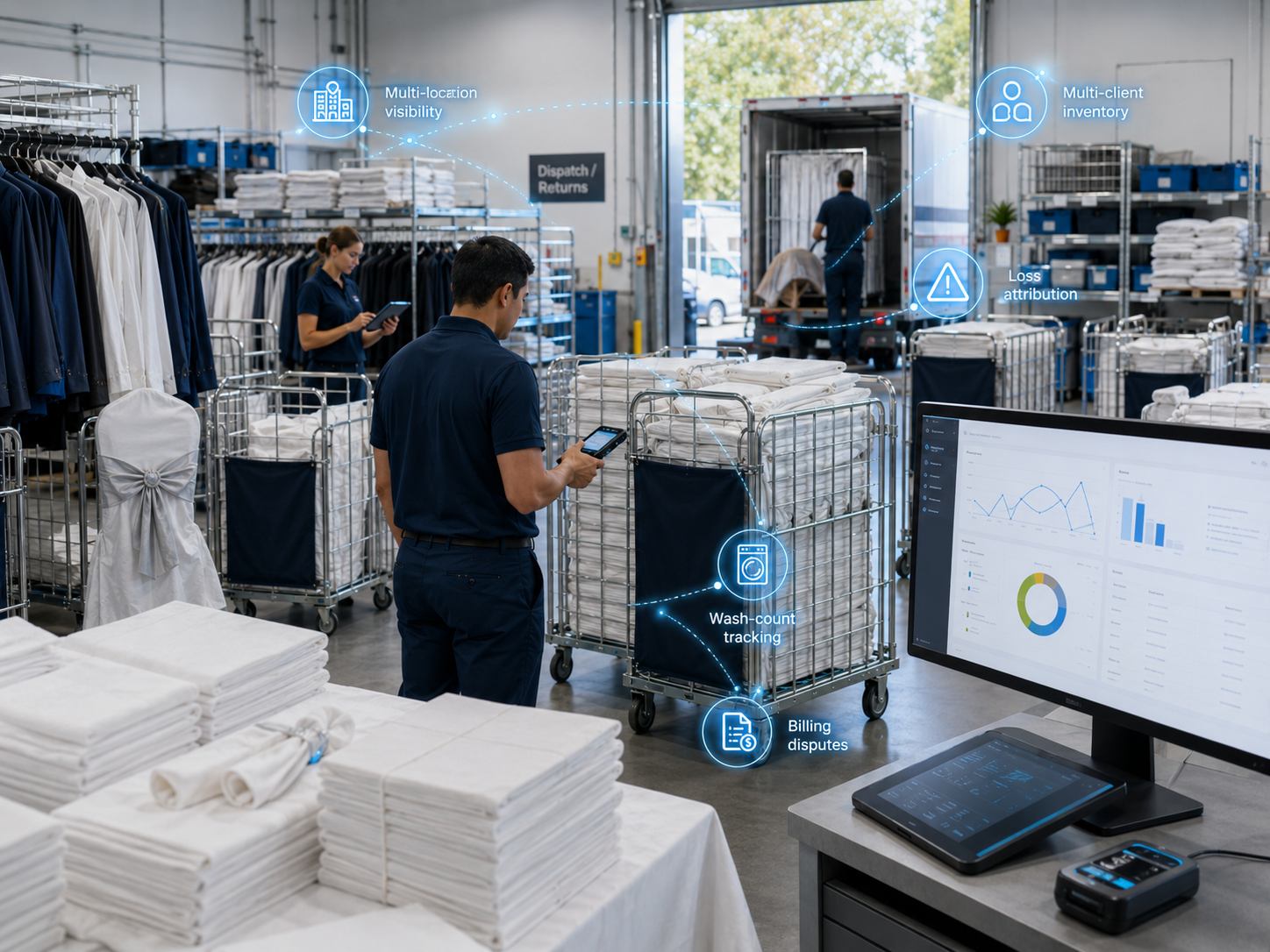
Textile and party rental tracking is more complex than standard laundry tracking because the same items circulate across multiple clients, sites, venues, contracts and wash cycles. Rental companies need to know not only whether an item was washed, but also which client had it, which event or site it was delivered to, whether it came back, how many times it has been used, and whether it should be billed, replaced or reported as missing.
- Multi-client inventory. Hundreds or thousands of textile items circulate across multiple client accounts simultaneously. Manual reconciliation is slow, error-prone and always out of date.
- Event and venue complexity. In party rental and event linen operations, tablecloths, napkins, chair covers, textile covers and event décor move quickly between warehouses, venues, clients and laundries, often with tight turnaround times.
- Loss attribution. Items go missing at client sites, event venues, laundry handovers, sorting points or in transit. Without item-level RFID data, it is difficult to know where a loss occurred or which client account is responsible.
- Billing disputes. Clients may dispute delivery counts, return quantities or missing items. Without verified records at every handover, disputes are resolved by negotiation rather than data.
- Fleet lifecycle management. Each item has a wash count and usage history. Without per-item lifecycle data, rental companies risk replacing textiles too early, too late or based on estimates rather than actual condition and usage.
- Multi-location visibility. Items assigned to one client site may be returned from another location or reused across different events. RFID follows the individual item, not just the batch.
SYSTEM OVERVIEW
Key components
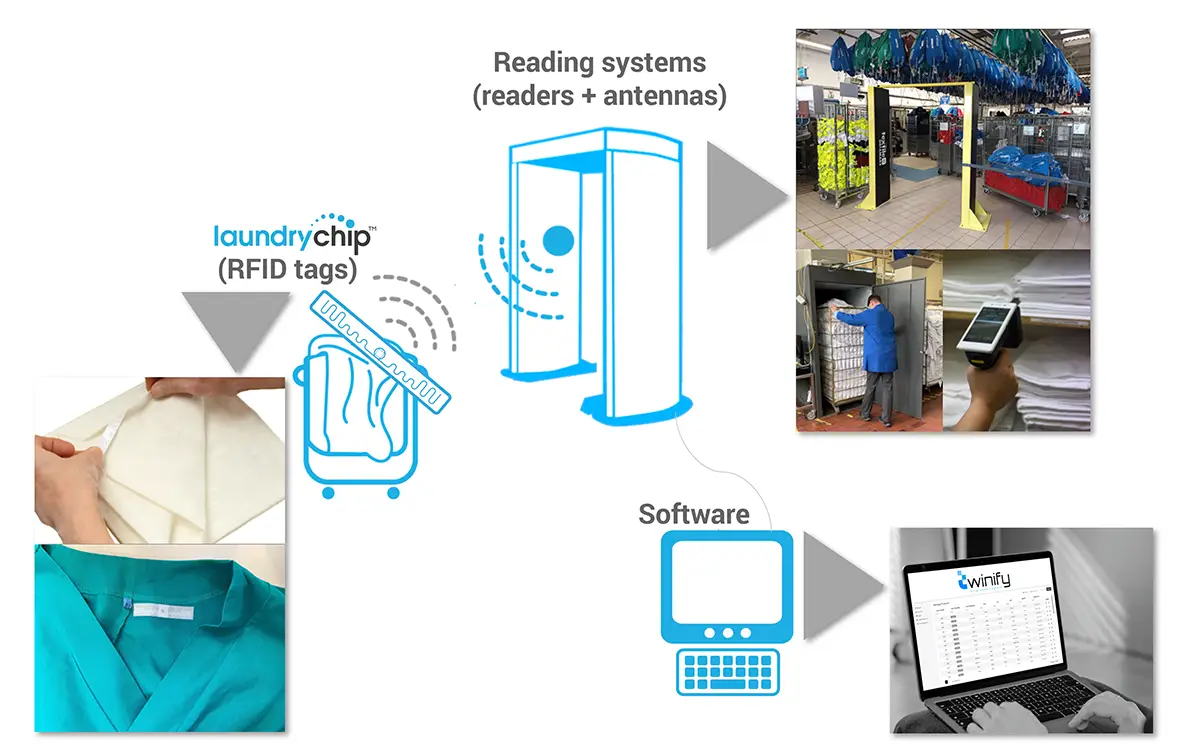
A complete RFID textile and party rental tracking system combines three connected layers: RFID tags for rental textiles, RFID reading systems and software integration. The tag gives every rental item a unique identity, the readers capture each movement automatically at handover points, and the software turns RFID data into usable information for client inventory, event delivery verification, billing, loss attribution, wash-count tracking, lifecycle management and customer reporting.

RFID tags for rental textiles
The LaundryChip™ is a durable, washable UHF transponder permanently embedded in each textile item. It withstands high-temperature industrial washing, chemical detergents, tumble drying, ironing and mechanical pressing across the full lifetime of the textile. Available formats include FT401 for flat linen and garments, FT403 for smaller items such as napkins and compact textiles, and patchable or in-pouch formats for retrofitting existing rental inventory. For new rental stock, source tagging during manufacturing is the most seamless option because items enter the fleet already identified. See the whole range: RFID LAUNDRY TAGS.

RFID reading systems
Purpose-built hardware captures item movements automatically at every key handover point in the rental cycle: dispatch, delivery, collection, laundry intake, processing, depot storage and redistribution. Pass-through portals verify outgoing and incoming batches per client account. Cabinet systems confirm stock levels and can read up to 1,000 items in 3 seconds. Handheld devices support delivery and collection verification at client sites or event venues. Tunnel systems support high-volume sorting and processing in large rental operations. For the full range of reading infrastructure and UHF RFID textile technology, see UHF RFID for textile services.

Software integration
Datamars provides two software layers that ensure the system runs reliably and that data reaches the right place. Storm monitors and manages all RFID devices across the installation. Cloudburst collects RFID read data and delivers it ready-to-use to third-party textile rental management software, ERP, billing systems and client portal platforms. Datamars relies on a wide and proven network of tracking software partners for the operational management layer. For the full system architecture, see RFID laundry management system.
Rental lifecycle tracking – PROCESS FLOW
How RFID textile rental tracking works across the rental cycle
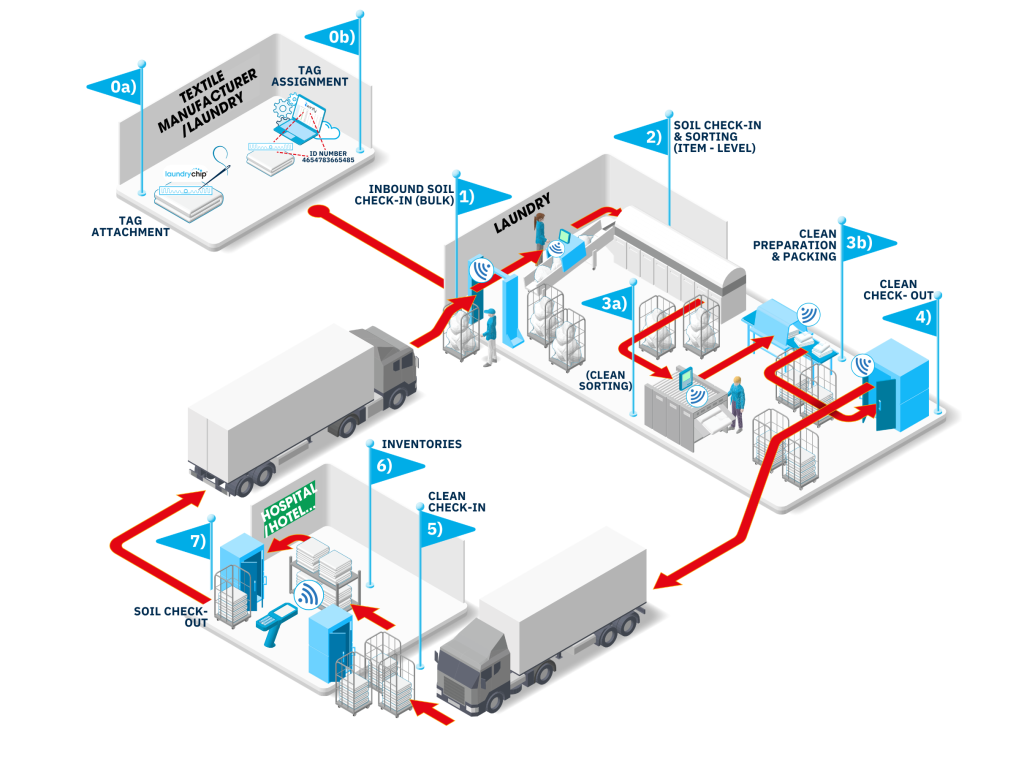
RFID textile rental tracking follows each item across the full rental lifecycle: fleet registration, client assignment, dispatch, delivery, use, return, laundry processing, redistribution and billing.
At every handover point, RFID readers capture item-level data automatically, creating a verified record of what was delivered, what was returned, which client account is responsible and which items are outstanding.

Tagging and fleet registration
New items enter the rental fleet already tagged or are retrofitted with a suitable LaundryChip™ format. Each item is linked to its textile type, size, client category, stock group and lifecycle record in the management software.

Client or event assignment and dispatch
Items are allocated to a client account, contract, site or event. A portal reader at dispatch verifies the outgoing batch: correct items, correct quantities and correct client attribution. The dispatch record is generated automatically.

Delivery, use and return
A handheld reader or fixed reading point confirms what was delivered, in what quantity, at what time and to which client site or event venue. At collection, RFID records what was returned and what remains outstanding. Missing items are immediately visible against the relevant client account, venue or event.

Laundry processing
Returned items are processed through the laundry. LaundryChips™ withstand the full wash cycle, and the wash count is updated per item after every cycle. Items approaching end-of-life are flagged before re-entering the rental fleet.

Redistribution
Clean items return to the depot or storage area. The system knows what is available, where it is, what condition it is in and which client or event it can be assigned to next.

Billing
Item-level data per client account, delivery, return and outstanding item feeds into the billing system through Cloudburst. Accurate RFID textile rental billing replaces manual reconciliation with verified records.
OPERATIONAL GAINS
Key benefits
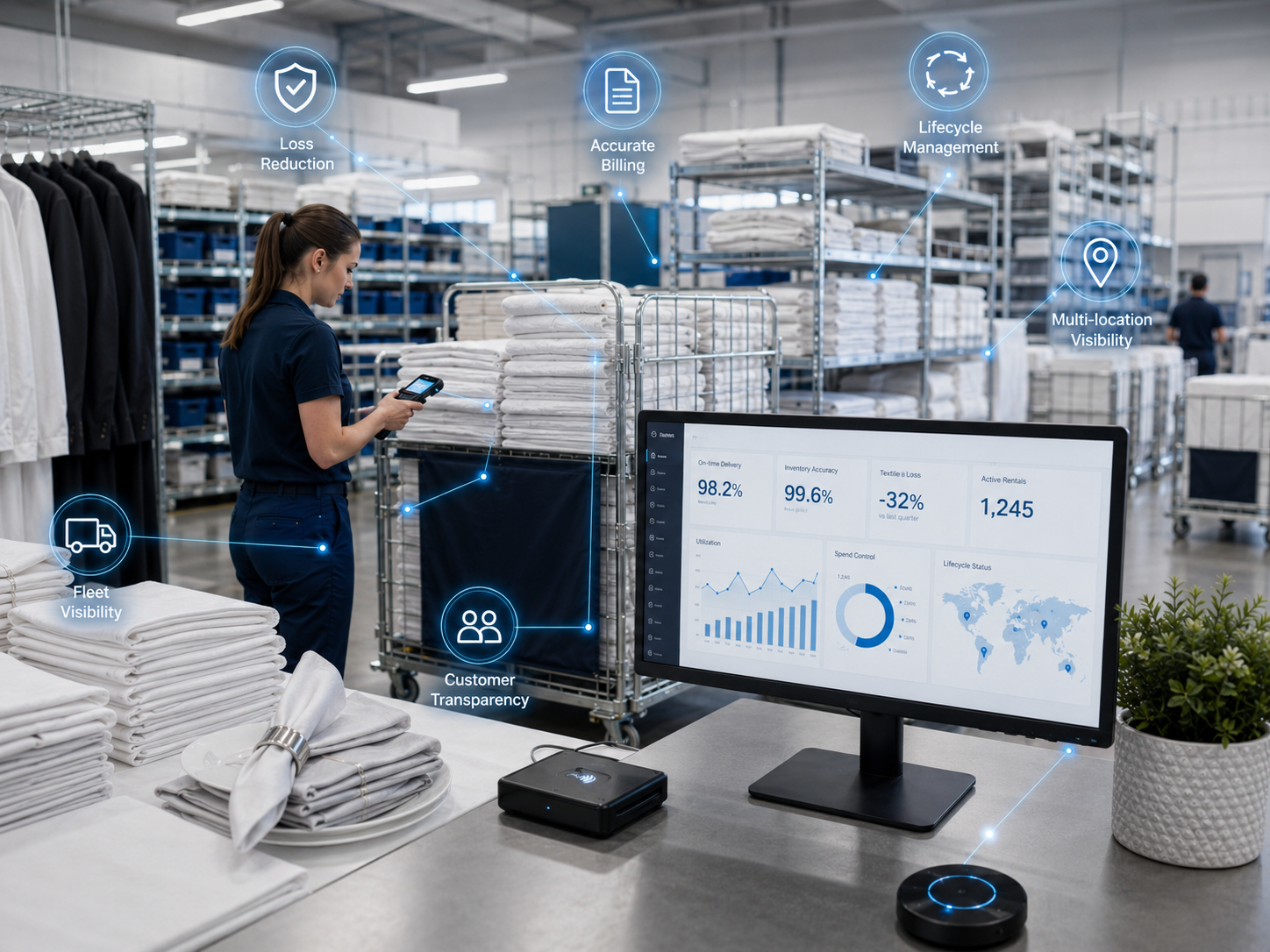
The main benefits of RFID textile rental tracking are real-time rental inventory visibility, loss accountability, accurate billing, client-level reconciliation, wash-count tracking, fleet lifecycle management, multi-location visibility and labor savings. By replacing manual counts with item-level RFID data, rental operators can reduce disputes, control losses and manage the full rental fleet with verified information.
- Real-time rental inventory visibility. Know exactly how many items are in the laundry, at the depot, in transit, at client sites, at event venues or missing.
- Loss accountability. Item-level records at every handover point identify exactly where losses occur and which client, venue or process stage is involved.
- Accurate RFID textile rental billing. Verified delivery and return records reduce invoice disputes and support automated billing feeds from RFID data.
- Lifecycle management across the rental fleet. Wash count per item, automatic end-of-life flagging and purchasing decisions based on actual fleet data help maintain quality without over-purchasing.
- Customer transparency. Clients receive verified delivery and return records, improving trust and reducing disputes over quantities or missing items.
- Multi-location tracking. Items are tracked across all client sites, event venues, depots and laundry processing points.
- Labor savings. Automated counting and reconciliation reduce manual inventory tasks, allowing staff to focus on higher-value work.
Textile and party rental use cases
Applications by sector
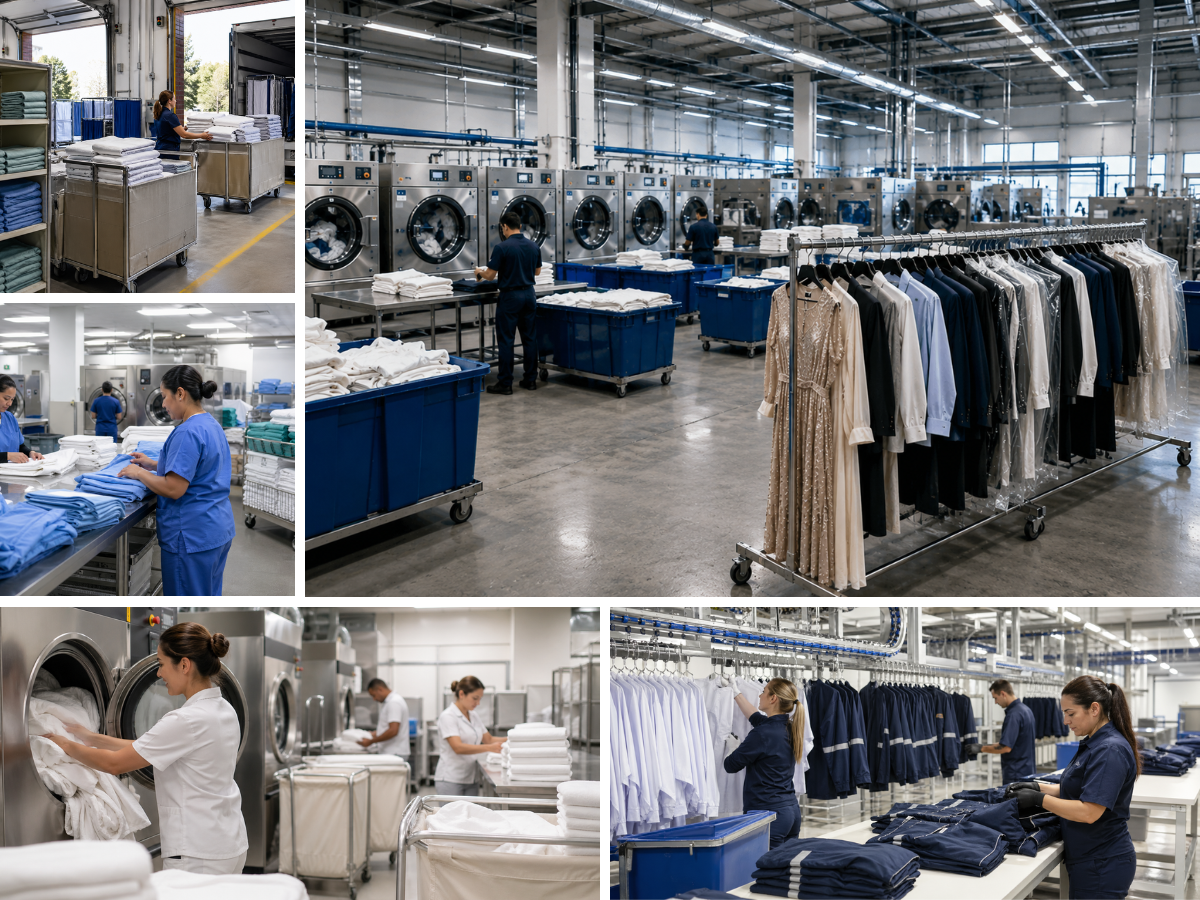
RFID textile rental tracking is used across all sectors of the rental textile industry, including textile rental, party rental, hospitality linen rental, healthcare linen rental, workwear rental, flat linen rental and restaurant linen rental. The rental model changes by sector, but the core requirement is the same: every item must be identifiable, traceable and billable across clients, locations and wash cycles.
- Industrial workwear rental. Garments tracked per employee, per client and per wash cycle, with support for PPE compliance documentation. See workwear and uniform tracking [/workwear-uniform-tracking/].
- Hospitality linen rental. Bed linen, towels, table linen and robes tracked per hotel property and per delivery cycle, with focus on loss prevention and billing accuracy at the hotel-laundry interface. See hotel linen tracking [/hotel-linen-tracking/].
- Healthcare linen rental. Patient linen, staff garments and surgical textiles tracked with wash-count and sterilization documentation, including MR Conditional and gamma-resistant tag options for specialized clinical environments. See healthcare linen and garment tracking [/healthcare-linen-garment-tracking/].
- Flat linen rental. High-volume sheet, towel, table linen and napkin rental for hotels, hospitals, restaurants and event operations, with tunnel and portal systems for maximum throughput. See RFID flat linen tracking [/rfid-flat-linen-tracking/].
- Party rental and event linen rental. Tablecloths, napkins, chair covers, table runners, textile covers and reusable event textiles tracked per client, venue, event, delivery cycle and return. RFID helps verify what was delivered, what came back and what is missing after each event.
- Restaurant and food service linen rental. Table linen, napkins and staff uniforms tracked per client and per delivery cycle.
For the full portfolio of solutions by sector and textile type, see RFID solutions specialized for any laundry sector and textile. For the broader context of RFID across the full textile lifecycle, see RFID textile tracking.
QUESTIONS & ANSWERS
Frequently asked questions
RFID textile rental tracking is the use of washable UHF RFID tags to identify, monitor and manage every rental textile item across its full rental lifecycle. Each garment, linen item, towel, tablecloth, napkin, chair cover, event textile, mat or reusable rental textile carries a LaundryChip™ with a unique digital identity. RFID readers capture each movement automatically at dispatch, delivery, collection, laundry intake, washing, redistribution and billing points. This creates a verified item-level record of what each client received, what was returned, what is missing, how many times each item has been washed and when it should be replaced.
RFID textile rental tracking is suitable for party rental companies when they manage reusable textile items such as tablecloths, napkins, chair covers, table runners, textile covers, event linen and other washable rental textiles. In party rental operations, items often move quickly between warehouses, venues, events, laundries and client sites. RFID creates a verified record of what was prepared, delivered, returned, washed and made available again for the next event. This helps reduce losses, avoid manual counting, improve customer accountability and support more accurate billing after each event.
RFID garment rental tracking works by giving each rental garment a permanent digital identity through a LaundryChip™. Readers at dispatch portals, client delivery points, return areas, laundry checkpoints and sorting systems capture garment movements automatically, without manual scanning and without line-of-sight. The data flows through Cloudburst to the rental management software, where operators can see live inventory per client account, wash count per garment, outstanding returns and item availability. This same logic applies to apparel rental, linen rental, workwear rental and party rental textiles.
RFID improves billing accuracy in textile and party rental by creating verified item-level records for every delivery, return and outstanding item. Instead of billing based on estimated quantities, manual counts or disputed paperwork, the rental operator can use RFID data to prove what was dispatched, what was delivered, what came back and what remains with the client or venue. This supports automated billing feeds, accurate client reconciliation and fewer invoice disputes. With Cloudburst, RFID read data can be delivered to rental management, ERP or billing software in a standardized format.
RFID reduces textile losses in rental operations by creating accountability at every handover point. Each rental item is read at dispatch, delivery, return, laundry intake, processing and redistribution. When an item does not appear where expected, the system can flag it as outstanding or missing against the relevant client account, venue, event, location or process stage. This makes it possible to identify where losses occur and who is responsible. Rental operators can move from general loss estimates to specific item-level loss attribution.
RFID can track rental textiles across multiple client sites and event venues because each item has a unique identity that follows it independently from the batch, cart or delivery route. If a textile is assigned to one client, delivered to an event venue, returned from another location, processed by the laundry and redistributed again, the RFID record stays linked to that item. This is especially useful for multi-site textile rental operations, party rental companies, hotel groups, healthcare networks and event linen providers managing thousands of items across many locations.
The RFID tags used for textile and party rental are durable washable transponders designed to survive industrial laundry conditions. Datamars rental tracking solutions use LaundryChips™, including FT401 for flat linen and garments, FT403 for smaller items such as napkins and compact textiles, and patchable or in-pouch formats for retrofitting existing rental inventory. For new rental stock, source tagging during textile manufacturing is usually the most seamless option because items enter the fleet already identified. For the complete tag range and selection guide, see RFID laundry tags.
The difference between RFID textile rental tracking and RFID laundry tracking is the operational perspective. RFID laundry tracking follows textiles through the laundry process: intake, washing, finishing, dispatch and return. RFID textile rental tracking follows the same items from the rental operator’s perspective: client assignment, venue delivery, event use, collection, billing, loss attribution and lifecycle management. In rental and party rental operations, both layers work together. The laundry system tracks processing, while the rental tracking system connects each item to clients, contracts, events and commercial workflows.
RFID rental tracking can integrate with existing ERP and billing software through the right data integration architecture. Datamars provides Cloudburst, which collects RFID read data from Datamars reading systems and delivers it in standardized formats to third-party rental management, ERP, billing, client portal or reporting platforms. This allows textile rental operators to add verified RFID data to their existing systems without replacing the software they already use. For the full integration architecture, see RFID laundry management system.
RFID textile rental tracking is suitable for garment rental because every garment can be linked to a client, wearer, department, size, wash cycle and lifecycle record. In garment rental and workwear rental operations, RFID supports employee assignment, issue and return tracking, laundry processing, redistribution, PPE wash-count documentation and item-level billing. It is especially useful for industrial workwear, uniforms, healthcare garments and protective clothing that move between the customer site, laundry and rental provider. For the garment-specific setup, see workwear and uniform tracking.
The ROI of RFID in textile and party rental operations usually comes from four main areas: lower textile losses, fewer billing disputes, reduced manual inventory work and better purchasing decisions. RFID creates verified item-level data on deliveries, returns, wash counts, outstanding items and end-of-life status. For party rental companies, RFID can also reduce post-event reconciliation time and improve accountability for missing table linen, napkins, chair covers and event textiles. The exact ROI depends on fleet size, loss rate, labor cost, client structure, event frequency and software integration scope.
RFID textile rental tracking is one application within the broader field of RFID textile tracking. Rental tracking focuses on client assignment, delivery, return, billing, loss attribution and fleet lifecycle management. RFID textile tracking is wider because it follows reusable textiles across their full lifecycle, from production and first use through laundry, service, maintenance, end-of-life and recycling. Twinify is the Datamars platform for full textile lifecycle visibility across all stages, including rental service life.
GET STARTED
Ready to take control of your rental fleet?
Every textile and party rental operation has different fleet volumes, client structures, textile categories, delivery models and billing workflows. Tell us about your fleet size, textile types, number of client accounts, laundry structure and current loss or billing challenges. We will recommend the right RFID textile rental tracking configuration for your process.
 Datamars | Textile ID