
RFID Textile Tracking
Full visibility over every textile item, from production to end-of-life
RFID textile tracking gives every reusable textile a permanent digital identity and follows that identity automatically across the full textile lifecycle: manufacturing, service, washing, redistribution, reuse and end-of-life. Each item carries a small RFID tag for textiles — the LaundryChip™ — permanently embedded in the textile at production or when the item enters service.
Every time the textile passes through an RFID reading point, its identity is captured automatically, without manual scanning and without line-of-sight. The system updates the item record with operational data such as location, status, customer allocation, wash count, lifecycle stage and end-of-life information.
The result is a continuous, item-level data trail that gives laundries, hotels, hospitals, workwear programs, textile rental companies and senior care operators full visibility over every textile asset. RFID textile management replaces estimates with real data, helping organizations reduce losses, automate inventory, improve lifecycle decisions and prepare for future circular economy and Digital Product Passport requirements.
Datamars Textile ID invented the first RFID laundry tag in 1990. Today, over 500 million LaundryChips™ are in service worldwide, across more than 10,000 installations in 65 countries.
STRATEGIC VALUE
Why track textiles with RFID
Most textile operations still rely on estimates: estimated stock levels, estimated loss rates, estimated replacement needs, estimated wash counts. Every estimate is a cost that nobody quantifies and nobody controls.
RFID textile tracking replaces estimates with data. Each item carries a permanent digital identity, read automatically at every stage of its lifecycle. The result is a continuous, item-level data trail from the moment a textile enters service to the moment it is retired.
This changes what textile management can do. Inventory is always accurate. Losses are traceable to a specific point and a specific moment. Replacement is driven by actual lifecycle data, not assumptions. Billing between laundry and client is based on verified records, not reconciliation. And operational decisions across purchasing, logistics and staffing are grounded in real numbers.
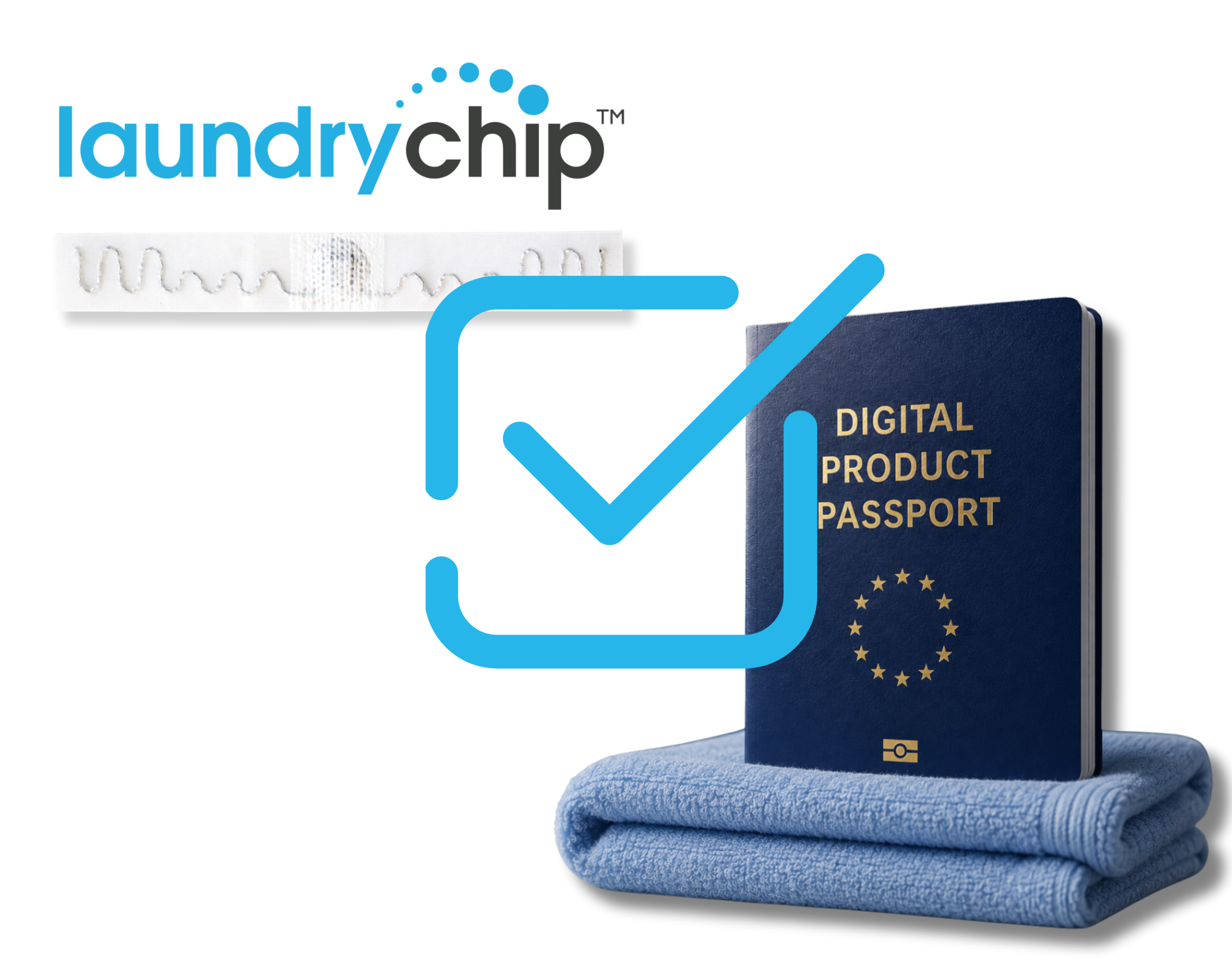
The same principle is now driving a broader shift. The EU Digital Product Passport for textiles will require manufacturers and service providers to document the full lifecycle of textile products: composition, origin, usage, repairability, recyclability. This is not a future scenario. It is regulation in progress, and the textile service industry will need the infrastructure to comply.
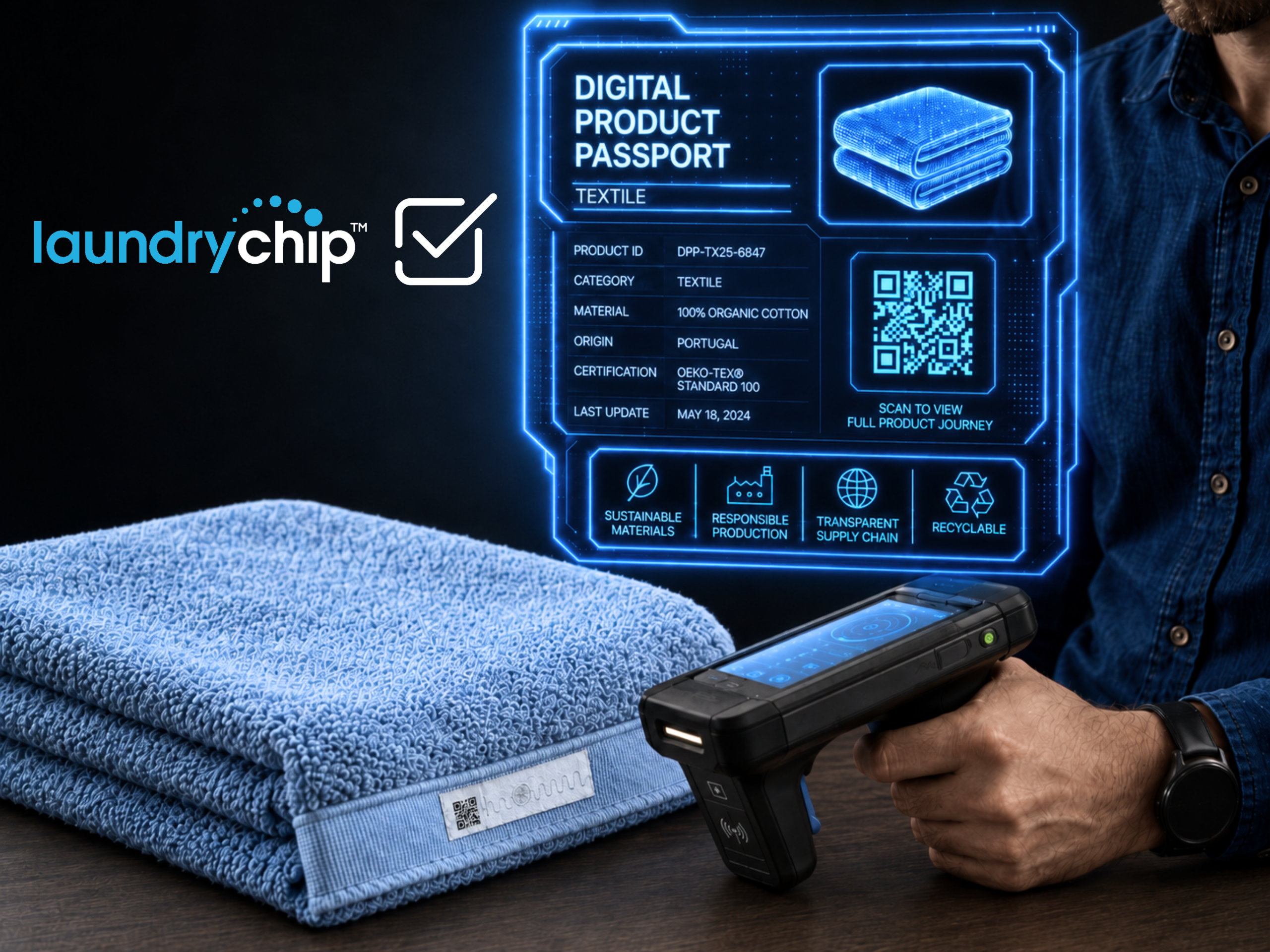
Datamars anticipated this direction with Twinify, a Digital Twin platform that creates a cloud-based digital record for each textile item, linking its physical LaundryChip™ identity to its full lifecycle data: origin, service history, wash count, condition and end-of-life status. Twinify turns RFID tracking data into the structured, item-level documentation that Digital Product Passport compliance will require.
For textile service providers and their clients, the implication is clear: the same RFID infrastructure that drives operational efficiency today is the foundation for regulatory compliance and circular economy reporting tomorrow.
SYSTEM OVERVIEW
Key components
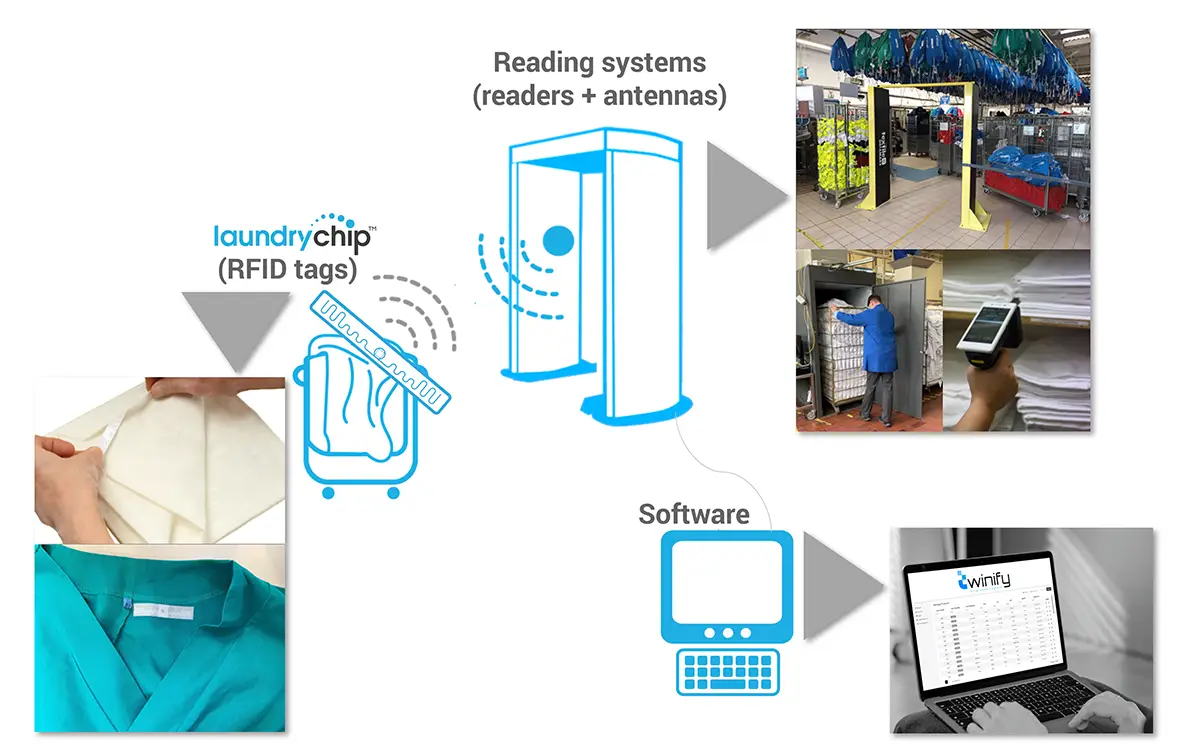
A complete RFID tracking system for textiles combines three connected core elements: RFID tags for textiles, RFID reading systems and software integration. The tag gives each textile item a permanent digital identity, the readers capture that identity automatically at key process points, and the software transforms each read into usable data for inventory control, wash-count tracking, lifecycle management, billing, reporting and end-of-life traceability.
RFID tags for textiles
The LaundryChip™ is a durable, washable UHF RFID transponder engineered to last the full lifetime of the textile. It withstands high-temperature industrial washing, chemical detergents, tumble drying, ironing and mechanical pressing. Available in multiple formats for different textile types and application methods: source tagging, patchable, in-pouch and vulcanized for mats and floor coverings. The FT401 (70 x 10 mm) is the standard format for flat linen and garments. The FT403 (37 x 15 mm) is for smaller items. Specific variants include integrated QR code (FT401-QR) or Datamatrix code (FT401-MX) for smartphone reading. The whole LaundryChip™ 40x and 50x families are OEKO-TEX Standard 100 certified. The FT401 is the only RFID laundry tag on the market with MR conditional certification for MRI environments.
RFID reading systems
Purpose-built hardware capture tag data automatically at selected points in the process, without manual scanning and without line-of-sight. Options include cabinets (up to 1,000 items in 3 seconds), pass-through portals, tunnel systems integrated into sorting and finishing lines, handheld devices and combo systems (UHF-HF-LF) for transitioning from older technologies.
Software
Tags and readers capture the data. Two Datamars software layers ensure the system runs reliably and that data reaches the right place. Storm monitors and manages all RFID devices across the installation. Cloudburst acts as a plug-and-play data integration layer: it collects RFID read data and delivers it ready-to-use to third-party textile management, laundry management or ERP software. Datamars relies on a wide and proven network of tracking software partners.
PROCESS FLOW
How RFID textile tracking works in practice
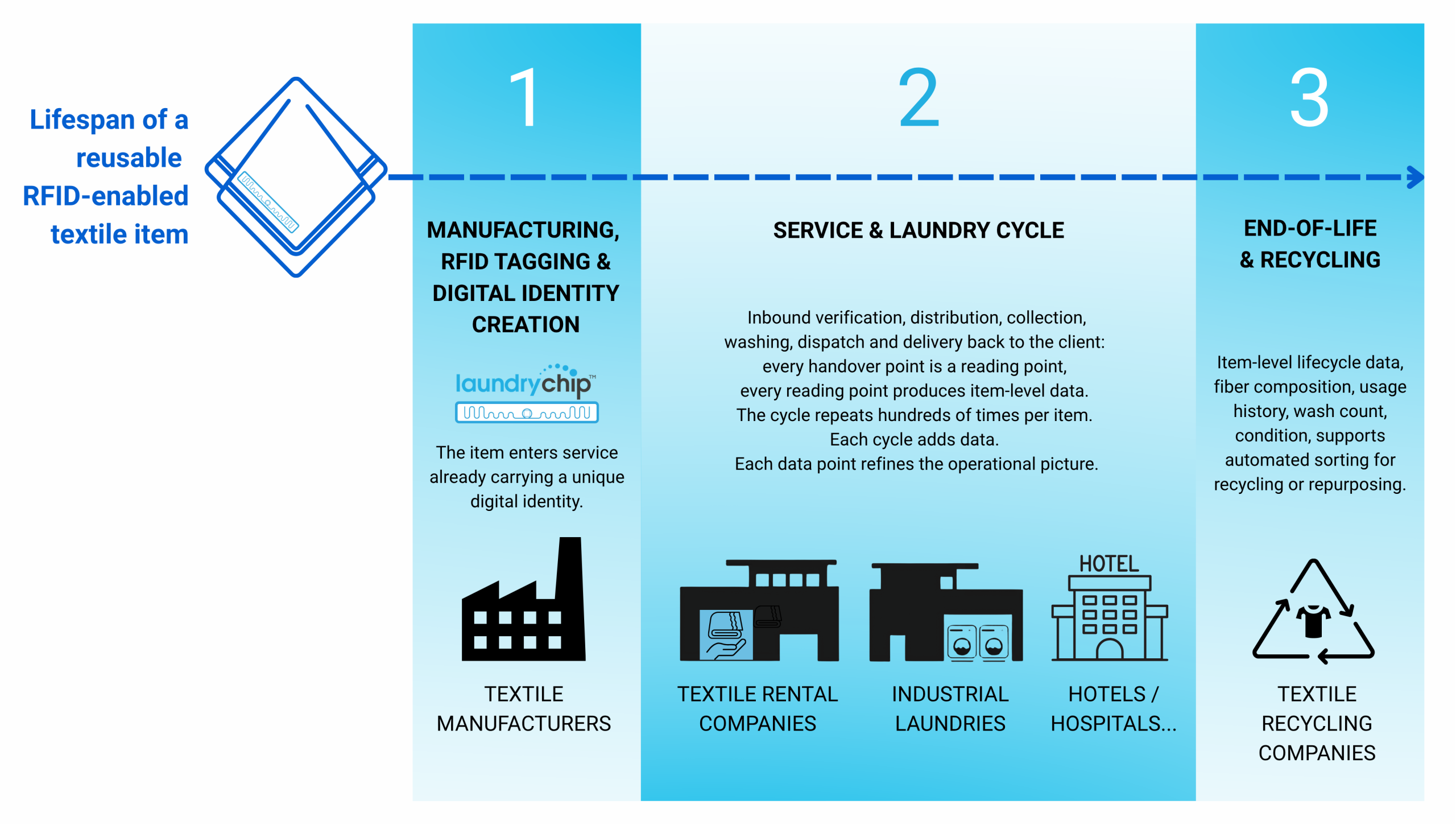
RFID textile tracking works by following each reusable textile item across its entire lifecycle, not only through the laundry process. The item can be tagged during manufacturing, tracked during active service, read automatically through washing and redistribution cycles, and finally identified at end-of-life for replacement, recycling or repurposing. This creates a continuous digital record from production to disposal, with the laundry cycle acting as the operational core where most RFID reads and lifecycle data are generated.

Manufacturing and tagging
The lifecycle begins at the textile manufacturer. When source tagging is used, the LaundryChip™ is embedded directly in the hem or seam during production. The item enters service already carrying a unique digital identity. No retroactive tagging, no disruption to downstream operations. For existing inventory entering the system for the first time, patchable and in-pouch formats allow tagging at the point of entry into service. In both cases, tagging is a one-time operation: once in place, the LaundryChip™ stays for the full lifetime of the textile.

Service and laundry cycle
This is where RFID laundry tracking takes over, and where the highest volume of data is generated. Inbound verification, distribution, collection, washing, dispatch and delivery back to the client: every handover point is a reading point, every reading point produces item-level data. The cycle repeats hundreds of times per item. Each cycle adds data. Each data point refines the operational picture. The logic is the same across sectors, whether the operation is an industrial laundry, a hotel, a hospital or a workwear program. For the full process breakdown, see RFID laundry tracking.

End-of-life and recycling
When an item reaches its wash count threshold or condition limit, the system flags it for replacement. But the data trail does not stop at retirement. Item-level lifecycle data, fiber composition, usage history, wash count, condition, supports automated sorting for recycling or repurposing. This is the foundation for circular economy workflows and for regulatory compliance including the EU Digital Product Passport for textiles. The Datamars Twinify platform links physical LaundryChip™ identity to full lifecycle records, turning operational tracking data into the structured documentation that end-of-life traceability requires.
OPERATIONAL IMPACT
Key benefits
The main benefits of RFID textile tracking are real-time traceability, automated inventory, linen loss reduction, accurate lifecycle management, lower manual counting costs, billing accuracy and better support for sustainability reporting. By turning every textile into a traceable digital asset, RFID helps organizations know where items are, how often they have been washed, when they should be replaced and how they can be managed at end-of-life.
Real-time traceability in linen management
Always know where every item is, when it was last read, how many times it has been washed and whether it is in service, in the laundry, in transit or missing.

Automated inventory
Up to 1,000 items read in 3 seconds, without manual handling. No more manual counts, no more reconciliation errors.
Linen loss reduction
Item-level accountability at every handover point. Pinpoint exactly where losses occur.
Accurate lifecycle management
Wash count per item, automatic end-of-life flagging, purchasing based on actual data.

Operational efficiency
Less labor on counting and reconciliation, more time on higher-value tasks.

Billing accuracy
Item-level data per client eliminates disputes and supports transparent reporting.

Sustainability and compliance
Lifecycle data supports circular economy workflows and regulatory reporting including the EU Digital Product Passport for textiles.
USE CASES
Common applications
RFID textile tracking is used across many textile service sectors, but the operational goal changes depending on the application. Industrial laundries focus on inventory accuracy, loss prevention and billing. Hotels focus on linen loss reduction and availability. Healthcare providers focus on hygiene traceability and MRI-safe tagging. Workwear programs focus on garment assignment, PPE traceability and automated dispensing. The technology is the same, but the RFID setup is configured around each sector’s textile types, workflows and data requirements.
Industrial laundries and textile rental companies.
High-volume, multi-client operations. Focus on inventory accuracy, loss prevention, accurate billing and client reporting. See RFID laundry tracking and RFID textile rental tracking.

Hospitals and healthcare.
Hospitals, clinics, care facilities. Patient linen, surgical textiles, staff garments. Focus on hygiene compliance, wash count traceability and MRI-safe tagging.
Hotels and hospitality.
Hotels, resorts, restaurants. Bed linen, towels, table linen, bathrobes, uniforms. Focus on linen loss reduction and inventory control across the hotel-laundry interface. See hotel linen tracking.

Workwear and uniforms.
Manufacturing, food processing, utilities, logistics. Automated dispensing, garment assignment by employee, PPE traceability. See Workwear and Uniform tracking.
Flat linen operations.
Sheet, duvet and pillowcase processing at high volume. Tunnel systems and pass-through portals for maximum throughput. See RFID flat linen tracking.
The full portfolio of solutions by sector and textile type is available in Our Solutions.
QUESTIONS & ANSWERS
Frequently asked questions
RFID textile tracking is the use of radio frequency identification to automatically identify and follow individual textile items across their full lifecycle. Each textile carries a unique RFID identifier, usually through a durable embedded tag such as the LaundryChip™. RFID readers capture that identity automatically at key points in the process, without manual scanning and without line-of-sight. The data flows to software, where it becomes operational information on inventory, item location, wash count, customer allocation, lifecycle status and end-of-life decisions. This allows reusable textiles to be managed as traceable assets instead of anonymous stock.
The difference between RFID textile tracking and RFID laundry tracking is mainly the scope of visibility. RFID laundry tracking focuses on the laundry process specifically: what enters the laundry, what is washed, processed, dispatched and returned, and how many wash cycles each item has completed. RFID textile tracking is broader because it follows the reusable textile across its full lifecycle, from production and first use through active service, washing, maintenance, end-of-life and recycling. The laundry process is one stage of that lifecycle. Twinify is the Datamars platform designed for full textile lifecycle visibility.
Many reusable textile types can be tracked with RFID textile tracking, including flat linen, terry items, garments, mats, mops, private wear and textile rental items. Typical examples include sheets, duvet covers, pillowcases, towels, bathrobes, facecloths, tablecloths, napkins, workwear, uniforms, patient gowns, staff scrubs, mats and mops. The right LaundryChip™ format depends on the textile type, available space, washing conditions and application method. Larger items may use formats such as FT401, while smaller items such as napkins or facecloths may require compact formats such as FT403.
UHF RFID, typically operating in the 860–960 MHz range, is the standard frequency used for RFID textile tracking in industrial laundry and textile service environments. UHF RFID enables bulk reading of many items at the same time, over longer distances and without line-of-sight. This is what makes high-throughput textile tracking possible in real operations, where hundreds or thousands of linen items, garments or rental textiles may need to be identified quickly in bags, trolleys, stacks or batches. For a full explanation of the technology, see UHF RFID for textile services.
Fabric tracking with RFID works by attaching or embedding a durable RFID tag, such as the LaundryChip™, into each textile item. The tag carries a unique identifier that is captured automatically by fixed readers, portals, tunnels, cabinets or handheld devices at defined process points. The data flows through Cloudburst to the operation’s management software, where staff can see live inventory, item location, wash count and lifecycle status. How to do fabric tracking with RFID depends on the textile type and process: tag format, reader placement and software integration are configured around the specific workflow, sector and data requirements.
RFID can support automating textile tracking for hotels and apparel rentals by replacing manual counting with automatic item-level identification. In hotels, RFID tracks linen, towels, robes, table linen and uniforms across the hotel-laundry interface, helping reduce losses and improve stock availability. In apparel rental and textile rental operations, RFID links each garment or textile item to a customer, contract, wash history, delivery record or lifecycle status. This supports accurate billing, loss attribution and multi-site inventory control. For hospitality applications, see hotel linen tracking. For rental workflows, see RFID textile rental tracking.
RFID solutions for textile industry management include the complete infrastructure needed to identify, read, manage and use textile data across industrial laundry and textile service operations. This includes RFID tags for textiles, application methods, RFID readers, portals, cabinets, tunnels, handheld devices, device monitoring and software integration. Datamars Textile ID provides the RFID hardware layer, including LaundryChips™ and reading systems, plus Storm for device monitoring and Cloudburst for data integration. These solutions support industrial laundries, hospitality, healthcare, workwear, textile rental and other reusable textile operations that need accurate inventory, traceability and lifecycle data.
A comprehensive guide to RFID laundry tags should explain what RFID laundry tags are, how they are applied to textiles, which formats are available, how they survive industrial washing and which tag is best for each textile type. The Datamars LaundryChip™ range includes multiple formats for different applications, including source tagging, patchable formats, in-pouch options and specialized versions for smaller textiles or smartphone identification. Tag selection depends on textile type, available space, wash conditions and reading requirements. For format selection, durability specifications, certifications and application methods, see RFID laundry tags.
Real-time traceability in linen management means knowing where every linen item is, when it was last read, which customer or location it belongs to, how many times it has been washed and whether it is in service, in the laundry, in transit or missing. With RFID, each item carries a LaundryChip™ and is read automatically at key process points, without manual counting and without line-of-sight. This gives laundries, hotels, hospitals and textile rental providers live item-level visibility on a management dashboard. Real-time traceability helps reduce losses, improve inventory accuracy, support billing and manage textile replacement based on lifecycle data.
RFID textile tracking can support the EU Digital Product Passport for textiles by creating persistent, item-level identification across the textile lifecycle. A durable RFID identity makes it possible to connect each physical textile to digital information such as origin, composition, service history, wash count, condition, repair, reuse and end-of-life status. This kind of structured lifecycle data is the foundation for circular economy reporting and future product passport workflows. The Datamars Twinify platform is designed to connect the physical LaundryChip™ identity to a cloud-based digital record for full textile lifecycle visibility.
RFID textile tracking can be suitable for small operations when the business needs better control over inventory, losses, wash counts or textile availability. The benefits of RFID are not limited to large industrial laundries: smaller laundries, hotels, care facilities or specialized textile service providers can also use RFID to automate counting, reduce manual checks and improve visibility. The right setup depends on textile volume, process complexity, number of reading points and operational goals. A smaller operation may start with selected textile categories or key checkpoints, then expand the RFID infrastructure as volumes or tracking requirements grow.
GET STARTED
Ready to track your textiles?
Tell us about your operation: sector, textile types, volumes and current challenges. We will identify which RFID solutions for textile industry management best fit your process and help you define the right starting point.
 Datamars | Textile ID