
Hotel linen RFID tracking
Stop losing hotel linen. Track every sheet, towel, robe and uniform with RFID.
Hotel linen tracking with RFID allows hotels, resorts and hospitality laundries to identify, count and monitor every linen item automatically throughout the full linen cycle. Each sheet, towel, robe, napkin, tablecloth or uniform carries a small, washable RFID linen tag — the LaundryChip™ — permanently embedded in the textile. RFID readers capture each item automatically at key checkpoints, without manual counting and without line-of-sight.
For hotels, this means real-time visibility over where each item is, how many times it has been washed, whether it has been delivered, distributed, collected, returned to the laundry or identified as missing. RFID hotel linen tracking helps reduce linen losses, avoid overstocking, improve laundry accountability and make sure clean linen is available where and when it is needed.
The result is better inventory control, fewer unresolved disputes with laundry partners, more accurate lifecycle data and more reliable guest service. Instead of estimating linen stock or manually counting items, hotels can manage linen with item-level data across the property, the laundry and the full return cycle.
SYSTEM OVERVIEW
Key components
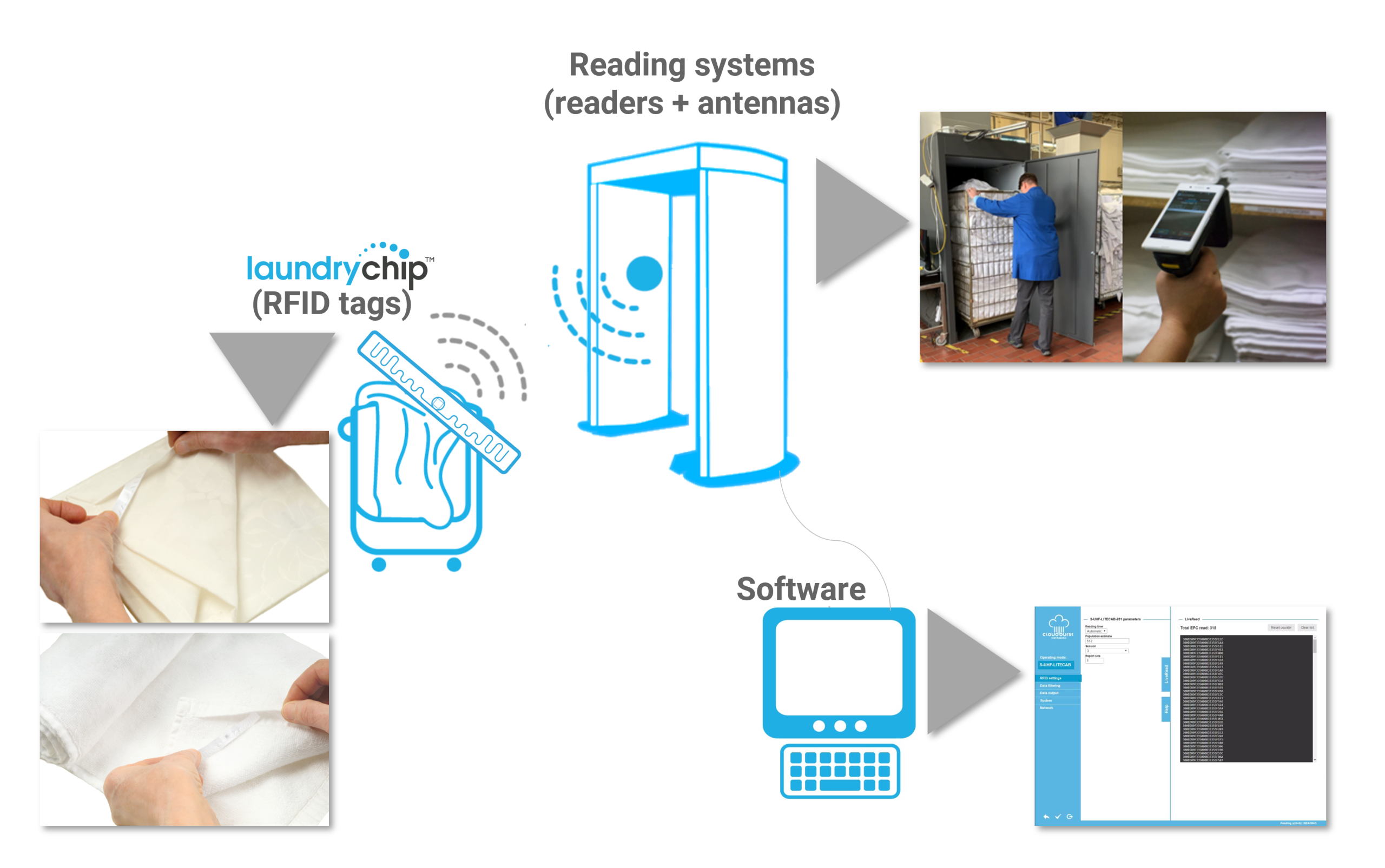
A complete RFID hotel linen tracking system combines RFID linen tags, RFID reading systems and software integration. The tag gives each linen item a unique digital identity, the reading systems capture item movements automatically at key checkpoints, and the software turns each read into usable data for inventory visibility, delivery reconciliation, wash-count tracking, loss control and hotel-laundry reporting.
RFID linen tags
The LaundryChip™ is a small, durable washable transponder permanently embedded in each textile item. It survives high-temperature washing, chemical detergents, tumble drying, ironing and pressing across the full lifetime of the textile. Tags are OEKO-TEX Standard 100 certified and available in formats suited to different textile types: the FT401 (70 x 10 mm) for flat linen, garments and towels; the FT403 (37 x 15 mm) for smaller items like napkins and facecloths. Specific variants include an integrated QR code (FT401-QR) or Datamatrix code (FT401-MX) for smartphone reading where dedicated readers are not available. Over 500 million LaundryChips™ are in service worldwide. Hospitality RFID tags are available as bulk RFID laundry tags for hotel management, with custom encoding and branding for hotel programs.
RFID reading systems
Purpose-built hardware reads tag data automatically at selected checkpoints: linen room entrances and exits, laundry dispatch and delivery points, floor service stations. Options include pass-through portals, cabinet systems (up to 1,000 items in 3 seconds), handheld devices for room-level checks and combo systems for operations running a mix of RFID technologies.
Software
Datamars provides two software layers that ensure the system runs reliably and that data reaches the right place. Storm monitors and manages all RFID devices across the installation. Cloudburst acts as a plug-and-play data integration layer: it collects RFID read data and delivers it ready-to-use to third-party RFID linen management and property management software. Datamars relies on a wide network of tracking software partners for the operational management layer.
PROCESS FLOW
How RFID linen tracking works in a hotel
RFID linen tracking works by following each tagged linen item through the full hotel linen cycle: clean delivery, check-in, distribution to floors or rooms, soiled collection, return to the laundry and final reconciliation. At each stage, RFID readers capture item-level data automatically, so hotel staff can see what is in circulation, what is at the laundry, what has been returned and what is missing, without manual counting.

Delivery from the laundry & clean check-in
A reading point at the hotel loading dock or linen room captures the incoming batch automatically: what arrived, in what quantity and from which supplier. Any discrepancy against the expected delivery is flagged immediately, before linen enters circulation.

Clean distribution to floors and rooms
Linen is issued from the linen room. Handheld readers or fixed checkpoints log what left the room and when. Floor-level reads confirm distribution to specific areas of the property and give the hotel full visibility over its inventory at any moment, floor by floor: exactly what is available, what is in use and what is missing.

Soiled linen collection
When housekeeping staff strip the rooms, soiled linen is often dropped through floor-level laundry chutes and transported down to a central collection room at the base of the hotel. RFID antennas installed in the collection area automatically identify each tagged item as it arrives, creating an immediate record of the linen collected from the hotel floors without manual counting or scanning.

Soil check-out and return to laundry
The outgoing batch is verified before the truck leaves: correct items, correct quantities, correct attribution to the hotel’s account.
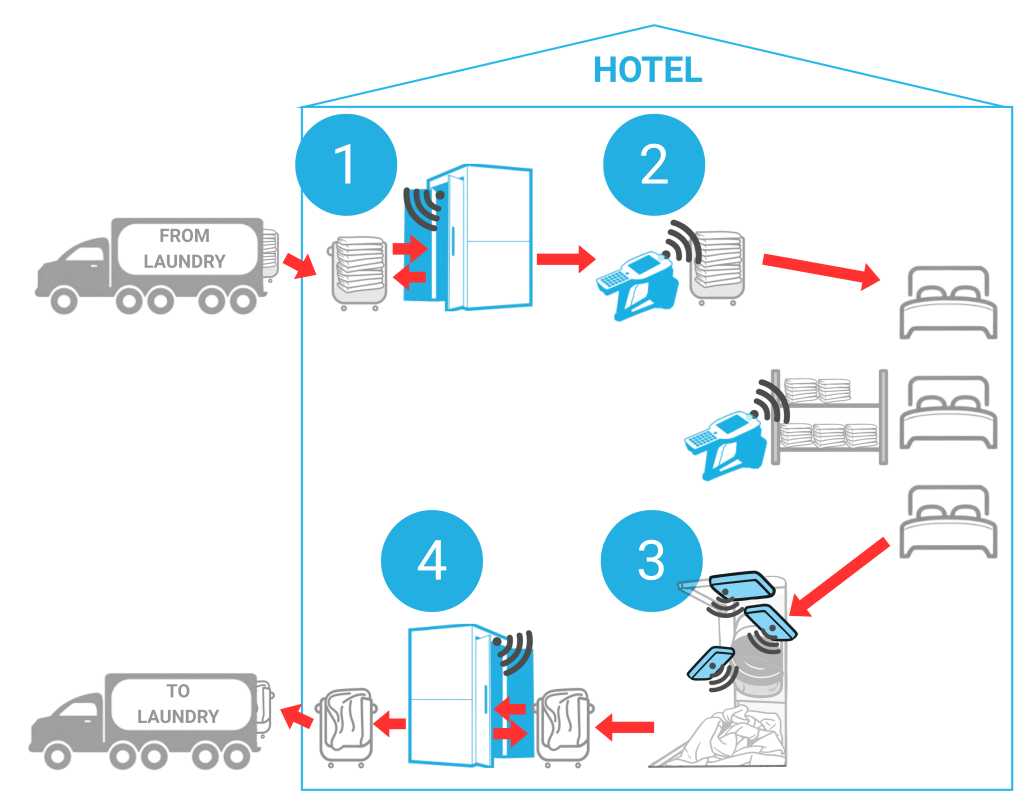
At every stage, the system maintains a live inventory. Staff know what is in circulation, what is in the laundry and what is missing.
OPERATIONAL GAINS
Key benefits
The main benefits of RFID hotel linen tracking are real-time inventory visibility, linen loss reduction, accurate wash-count records, fewer disputes with laundry partners, lower manual counting costs and better purchasing decisions. By turning every linen item into a traceable asset, RFID helps hotels control linen movement, reduce unnecessary replacement costs and make sure clean stock is always available for guests.

Real-time inventory visibility
Always know how many items are in service, in the laundry, in transit or missing, without manual counting. Clean stock requirements are always visible, so the hotel can act before shortages reach the guest. The result is consistent linen availability and a higher standard of service.
Linen loss reduction
Identify exactly where losses occur and when. Hotels using rfid linen tracking typically reduce annual linen loss from 15-20% to 3-5%.
Accurate wash count per item
Retire linen at the right time, based on actual lifecycle data, not estimates. This reduces both premature replacement cost and the risk of worn items reaching guest rooms.

Fewer disputes with the laundry
Item-level records shared across the laundry-hotel interface eliminate the ambiguity behind most billing and loss disputes. This is how RFID linen management smarter hospitality lower costs translates into practice.
Lower labor cost
Automated counting at every checkpoint removes the need for manual linen audits. How RFID textile management reduces management costs is straightforward: housekeeping time freed from inventory tasks is redirected to guest service.

Better purchasing decisions
Accurate lifecycle data allows purchasing based on real replacement needs rather than buffer stock. PAR levels can typically be reduced from 6 or more to 3-4 once accurate inventory data is available.
DEPLOYMENT SCENARIOS
Common applications
- Hotels with external laundry partners. The primary focus is loss prevention at the handover points between hotel and laundry, and accurate reconciliation of deliveries. RFID creates a shared, verifiable record that benefits both parties.
- Hotels with in-house laundry. Full cycle tracking: from linen room to floor, through collection, washing and return. Focus on inventory accuracy, wash count and staff efficiency.
- Resorts and large properties. Multiple buildings, multiple linen rooms, multiple distribution points. Linen tracking technology handles scale without proportional increase in labor.
- Hotel groups and chains. Centralized visibility across multiple properties. Standardized tracking data for group-level reporting, benchmarking and procurement planning.
- Restaurants and food and beverage operations within hotels. Table linen, napkins, rfid towel tracking and uniforms. Same system, same tags, integrated into the hotel-wide linen cycle.
- Hotels that outsource linen to a textile rental provider. RFID tracks items across the full rental cycle, supporting accurate billing, loss attribution and contract management between hotel and supplier.
For the full portfolio of solutions by sector, role and textile type, see our RFID solutions specialized for any laundry sector and textile.
CASE STUDY
90% Less Time Counting Linen. 100% Traceability. How Marriott in China Did It with RFID.
Across three luxury Marriott hotels in China, 150,000 bed sheets, towels and bathrobes were equipped with Datamars UHF LaundryChip™ 401 tags to create a fully traceable, item-level linen management process. By combining RFID bulk reading at clean and soiled linen handovers with handheld scanning for housekeeping and inventory control, the hotels reduced linen counting and housekeeping reporting time from 90 to 10 minutes, while warehouse stocktaking dropped from 5 hours to 1. The result is faster operations, more accurate inventory data, clearer accountability at every handover point and more reliable linen availability to support a consistently high level of guest service.
QUESTIONS & ANSWERS
Frequently asked questions
RFID linen tracking in hotels works by giving each textile item a unique digital identity through a small, washable LaundryChip™ embedded in the linen. RFID readers placed at key checkpoints — such as the laundry delivery dock, linen room, floor service areas and return points — capture item movements automatically, without manual counting and without line-of-sight. The data flows through Cloudburst into the hotel’s RFID linen management or property management software, where staff can see live inventory, deliveries, returns, wash counts and missing items. For the full system overview, see RFID laundry tracking.
Hotels without RFID linen tracking typically lose a significant share of their linen inventory every year, often estimated at 15 to 20 percent of total stock. Sheets, towels, robes, napkins and uniforms can disappear at the laundry, during transport, inside the property or at handover points, and manual processes usually make it difficult to identify exactly where the loss occurred. RFID linen loss reduction works by creating accountability at every checkpoint and showing which items were delivered, distributed, collected and returned. With item-level visibility, hotels can often reduce linen loss to around 3 to 5 percent.
RFID linen tags used in hotel laundry must survive repeated industrial washing, chemical detergents, water extraction, tumble drying, ironing and mechanical pressing. LaundryChips™ are engineered for these conditions and are designed to remain attached, readable and reliable across the full lifetime of the textile. For workwear applications, Datamars guarantees a minimum durability of 200 industrial wash cycles, while actual performance depends on tag variant, textile type, application method and wash conditions. LaundryChips™ do not need to be removed before washing, drying or finishing. For the complete tag specifications, see RFID laundry tags.
The best RFID tags for hotel flat linen depend on item size, hem space and reading requirements. For high-volume flat linen such as sheets, duvet covers, pillowcases and towels, the FT401 format, measuring 70 x 10 mm, is typically the standard choice. For smaller items such as napkins, facecloths and small towels, the FT403, measuring 37 x 15 mm, is better suited to limited hem space. Both are UHF LaundryChips™ with strong bulk-reading performance. See RFID flat linen tracking for the full flat linen setup, and RFID laundry tags for the complete tag selection guide.
RFID linen tags can be read in bulk when they use UHF RFID technology, which is the standard for high-volume hospitality and laundry operations. UHF LaundryChips™ can read up to 1,000 items in 3 seconds, without separating linen items, opening every bundle or handling each textile individually. No line-of-sight is required, so tagged sheets, towels, robes or napkins can be read in bags, trolleys, stacks or batches. This makes linen room stock counts, laundry deliveries and return checks much faster and more accurate. For the full explanation, see UHF RFID for textile services.
RFID linen tags based on standard UHF technology normally require a dedicated RFID reader to capture the tag wirelessly. However, Datamars offers specific LaundryChip™ variants, including FT401-QR and FT401-MX, with an integrated QR code or Datamatrix code printed on the tag. These versions allow item-level identification with any standard smartphone camera when a dedicated RFID reader is not available. Smartphone reading can be useful for room-level checks, spot verification, exception handling or operational areas where installing a fixed reader is not practical. The RFID function remains the core tracking technology, while the printed code adds a flexible manual identification option.
The same RFID hotel linen tracking system can also track hotel staff uniforms, housekeeping garments, F&B uniforms and other workwear items. Each garment receives a LaundryChip™ and can be linked to a department, role, wearer, stockroom, laundry process or replacement schedule. This allows hotels to manage uniforms with the same item-level visibility used for sheets, towels and robes. For more advanced workwear requirements, such as garment assignment by employee, automated dispensing, PPE traceability, repair workflows or controlled return systems, the setup may require specific readers and software functions. See workwear and uniform tracking.
RFID hotel linen tracking can apply to hotels with medical facilities, wellness clinics, spas or clinical textile workflows, but healthcare-related environments may require additional tag and process requirements. Textiles used in medical or clinical areas may need stricter hygiene control, item traceability and, in some cases, MRI compatibility. The LaundryChip™ FT401 is MR Conditional certified, making it suitable for use in MRI environments when the correct conditions are respected. This is particularly relevant for facilities connected to healthcare, diagnostics or imaging services. For healthcare-specific RFID textile setups, see healthcare linen and garment tracking.
The difference between hotel linen tracking and RFID laundry tracking is mainly the operational perspective. Hotel linen tracking follows linen from the hotel’s point of view: clean delivery, hotel check-in, linen room stock, distribution to floors or rooms, soiled collection and return to the laundry. RFID laundry tracking focuses on the laundry operation itself: what enters the laundry, what is processed, washed, finished, dispatched and returned. For hotels with an external laundry partner, both perspectives connect at the handover points. For hotels with an in-house laundry, both are part of the same end-to-end RFID system.
An RFID laundry management system is the broader operational platform that uses RFID data to manage laundry and textile workflows. Hotel linen tracking is one application within that wider system, focused on the movement, availability, wash count and loss control of hotel linen. A complete laundry management system may also cover inventory control, customer workflows, production planning, billing, reporting, ERP integration and supplier processes. Datamars provides the RFID infrastructure layer — LaundryChips™, RFID readers and Cloudburst integration — while the full operational management software is provided through Datamars’ network of tracking software partners.
UHF RFID matters for hotel linen tracking because it enables fast bulk reading of large quantities of linen at the same time, over longer distances and without line-of-sight. In hospitality operations, this means a full linen delivery, trolley, bag, stockroom section or return batch can be read in seconds instead of counted manually item by item. UHF RFID is the technology that makes high-throughput linen tracking practical for hotels, resorts and laundry partners, especially where large volumes of sheets, towels, robes and table linen move every day. For a full explanation, see UHF RFID for textile services.
RFID hotel linen tracking is one application within the broader field of RFID textile tracking. Hotel linen tracking focuses on hospitality textiles as they move through the hotel and laundry cycle, while RFID textile tracking covers the full lifecycle of reusable textiles: production, first use, active service, washing, maintenance, end of life and recycling. For hotels interested in sustainability, lifecycle visibility, replacement planning and circular textile management, this broader approach becomes especially relevant. The Datamars Twinify platform is designed to support textile lifecycle tracking from manufacture to recycling.
RFID can be added to existing hotel linen inventory using LaundryChips™ in application formats designed for retrofitting. Patchable and in-pouch formats can be applied to textiles that are already in circulation, allowing hotels to start tracking existing sheets, towels, robes, napkins or uniforms without replacing the entire stock. For new linen purchases, source tagging during manufacturing is usually the most seamless option, because the LaundryChip™ is embedded directly into the hem or seam before the item enters service. The best approach depends on textile condition, available space, wash process and rollout strategy.
RFID linen tags do not affect the feel or appearance of hotel textiles when they are correctly selected and applied. LaundryChips™ are small, compact transponders designed to be embedded in the hem or seam of the textile during manufacturing or as part of the application process. Once in place, they are generally invisible and do not change the fabric surface, texture or guest-facing appearance of sheets, towels, robes, napkins or table linen. Correct tag placement is important to preserve comfort, aesthetics and textile performance while still enabling reliable RFID reading throughout the laundry cycle.
RFID can track linen across multiple hotel properties when the system architecture is designed for multi-site visibility and centralized data management. Hotel groups and chains can use RFID to monitor linen inventory, deliveries, returns, losses, wash counts and replacement needs across several properties. This helps create standardized RFID linen management reporting, compare performance between hotels, support group-level procurement planning and identify recurring loss points. Multi-property tracking is especially useful for hotel groups sharing laundry providers, central warehouses or textile rental contracts. With the right reader infrastructure and software integration, each property can maintain local control while group management sees the broader picture.
The ROI of RFID linen tracking for hotels depends on linen volume, current loss rate, laundry model, labor cost, replacement cost and the level of manual counting in the operation. The main financial levers are RFID linen loss reduction, lower buffer stock, fewer labor hours spent on manual inventory, fewer disputes with laundry partners and better purchasing decisions based on real lifecycle data. Hotels often use RFID to reduce linen losses from around 15–20 percent to 3–5 percent, and to reduce PAR levels once inventory data becomes reliable. Contact us to calculate the potential ROI based on your specific property and linen flow.
GET STARTED
Ready to stop losing linen?
Tell us about your property: number of rooms, textile types, whether you work with an external laundry or run your own, and the scale of your current losses. We will recommend the right RFID hotel linen tracking system and help you calculate what it is worth.
 Datamars | Textile ID