
RFID Laundry Management System
One system to manage your entire laundry operation, from tag to dashboard.
An RFID laundry management system connects textile identification, reading infrastructure and software integration into one data architecture for industrial laundry operations. Every textile item carries a LaundryChip™ with a unique digital identity. Every movement is captured automatically. Every wash cycle is recorded. Every inventory, billing, reporting and lifecycle decision is based on verified item-level RFID data.
This is what RFID laundry management makes possible: a laundry operation where manual counting is reduced, inventory is visible in real time, losses are traceable, client billing is verifiable and replacement decisions are based on actual usage data, not estimates.
Datamars Textile ID provides the complete RFID infrastructure layer: LaundryChips™, reading systems, Storm for RFID device monitoring and Cloudburst for data integration. This open architecture connects RFID data to the laundry’s existing management software, ERP, billing platform or reporting system, without forcing the laundry to replace the operational software it already uses.
SYSTEM OVERVIEW
What an RFID laundry management system includes
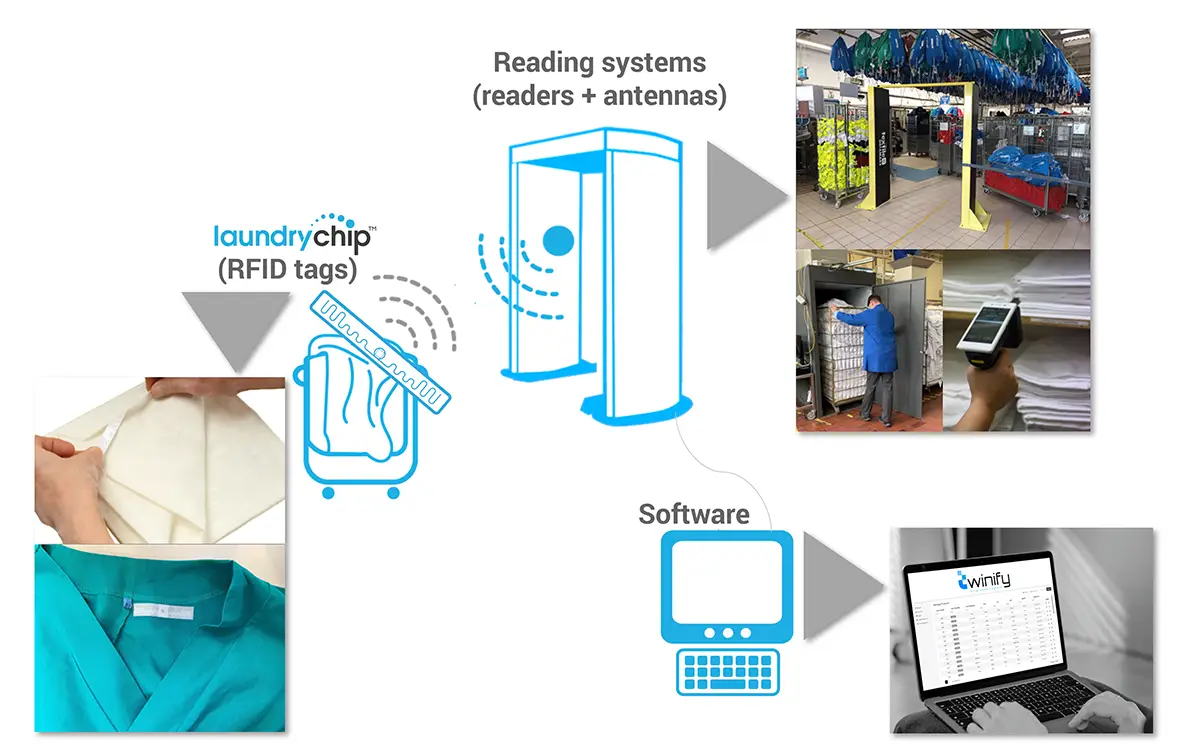
A complete RFID laundry management system combines three essential layers: RFID tags, RFID reading infrastructure and software integration. The tags give every textile item a unique identity, the readers capture item movements automatically at key process points, and the software layer turns RFID reads into usable data for inventory visibility, wash-count tracking, client billing, reporting, lifecycle management and process control.
RFID laundry tags
Every textile item carries a LaundryChip™, a washable UHF RFID transponder permanently embedded in the textile. It is the identity of the item. Without a reliable, durable tag that survives the full lifetime of the textile, the system has no data to work with. Datamars invented the first RFID laundry tag in 1990. Over 500 million LaundryChips™ are in service worldwide across more than 10,000 installations in 65 countries.
RFID reading infrastructure
Purpose-built hardware captures tag data automatically at every key process point in the laundry: intake, sorting, washing, finishing, storage and dispatch. Pass-through portals, tunnel systems, cabinet readers (up to 1,000 items in 3 seconds), handheld devices and combo systems for multi-technology environments. Without the right reader infrastructure placed at the right process points, data is incomplete.
Software integration
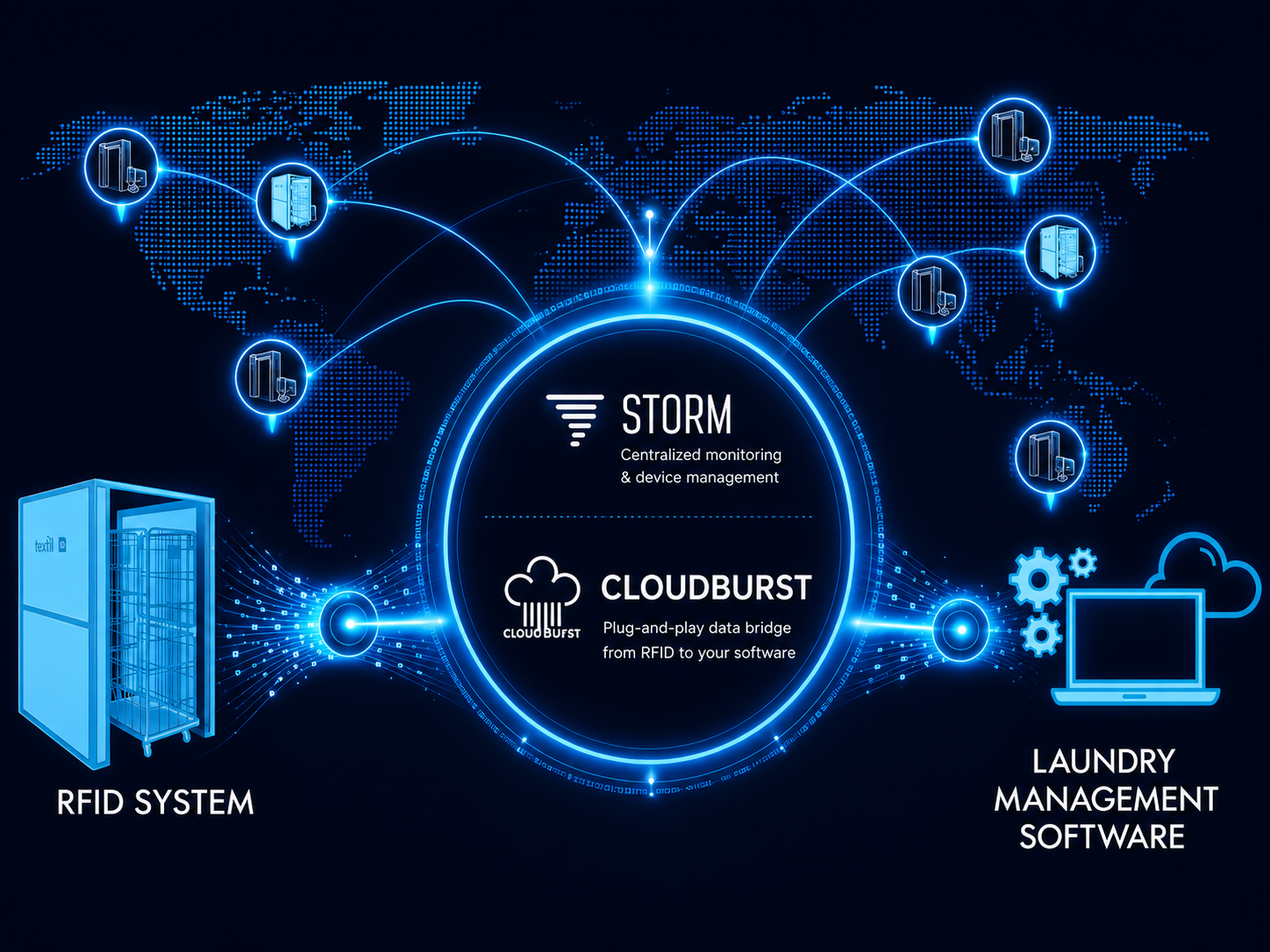
This is where RFID data becomes operational intelligence. Datamars provides two software layers: Storm for RFID device monitoring and Cloudburst for data integration. Storm monitors RFID readers and infrastructure in real time, helping prevent downtime, manage configurations and keep the reading network reliable. Cloudburst acts as a plug-and-play bridge between RFID read data and the laundry’s existing management software, ERP, billing system or client portal. It collects data from all reading points and delivers it ready-to-use to third-party systems. Datamars does not provide the laundry management software itself. That operational layer is delivered by Datamars’ network of software partners. This open architecture allows laundries to keep their existing platform and enrich it with RFID data, instead of replacing systems that already work.
Laundry workflow automation
How the RFID system works across the laundry operation
An RFID laundry management system follows each textile item across the full laundry workflow: intake, sorting, washing, finishing, storage, dispatch, delivery and return. At each stage, RFID readers capture item-level data automatically, while Storm keeps the reading infrastructure reliable and Cloudburst delivers verified RFID data to the laundry’s existing management software. This creates a continuous operational record from arrival to delivery.

Collection and check-in
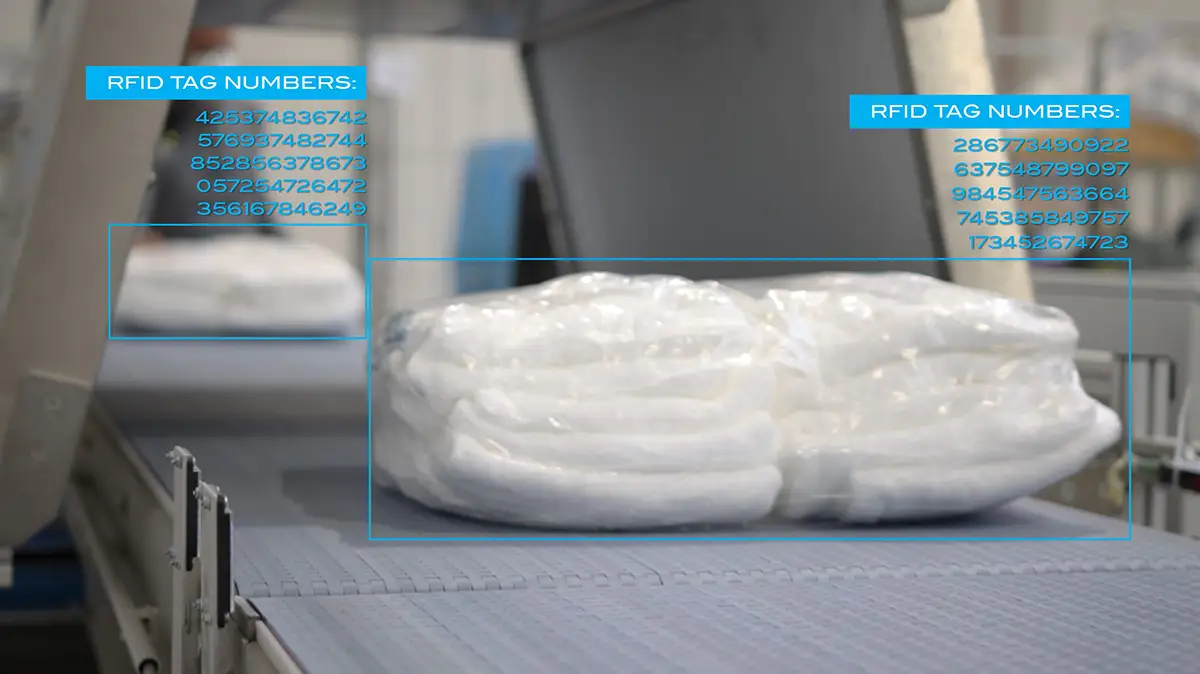
Soiled items arrive in carts or bags. A tunnel reader or pass-through portal reads the entire load as it enters the facility: item count, item identity, client attribution. No unpacking. No manual counting. Discrepancies against the expected delivery are flagged immediately. The system knows what arrived, from which client and in what quantity, before the items reach the sorting area.

Sorting
Items move to the sorting area. RFID data from the intake read is already in the system. Sorting by client, textile type and wash program is guided by real data, not manual identification. Errors are reduced. Processing speed increases.

Washing and finishing
LaundryChips™ remain attached through the full wash cycle. They withstand the complete range of industrial laundry conditions. After finishing, a reading point confirms processing and updates the wash count for each individual item. Items approaching end-of-life threshold are flagged automatically.

Storage and dispatch
Clean items move to storage. Cabinet systems or portal readers confirm stock levels per client in real time. At dispatch, the outgoing batch is verified: correct items, correct quantities, correct client allocation. The dispatch manifest is generated automatically. Discrepancies are resolved before the truck leaves.

Delivery and return
At the client site, delivery is confirmed by a reading point or handheld device. Returns are logged. The full cycle closes. Every handover point has a verified, item-level record.
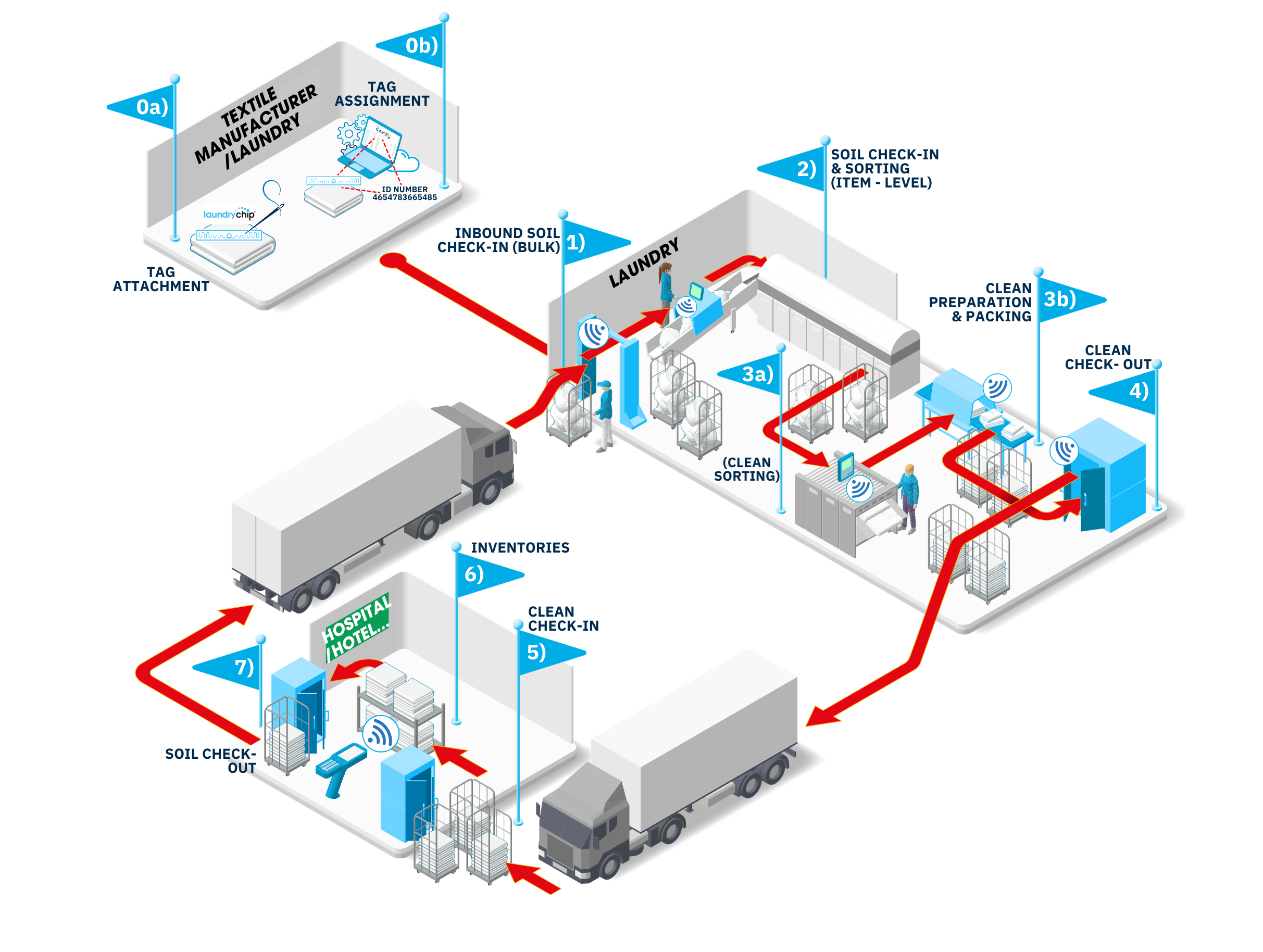
At every stage, operators see live inventory, item movement and wash count data on a single dashboard. For more background on why RFID is used in laundry operations, see Why use RFID in the laundry sector.
RFID laundry data management architecture
Storm and Cloudburst: the Datamars software layer
The Datamars software layer is built around two complementary tools:
- Storm: device monitoring and management. When an RFID reader goes offline or degrades in performance, data gaps appear in the system. Staff may not notice immediately. By the time the problem is identified, hours of reads may be missing. Storm prevents this. It monitors all RFID devices across the installation continuously, alerts on anomalies, manages configurations remotely and provides a centralized view of the entire reading network. For large installations with multiple reading points and sites, Storm is the operational backbone that keeps the data layer reliable.
- Cloudburst: plug-and-play RFID data integration. Every laundry already has management software. The challenge is connecting RFID data to it without a costly custom integration project. Cloudburst solves this. It is a purpose-built middleware layer that collects RFID read data from all Datamars reading systems and delivers it in a standardized, ready-to-use format to any third-party platform: laundry management software, ERP, billing system, client portal or analytics tool. Plug-and-play deployment. No custom development required on the laundry side. Real-time laundry tracking software output available from day one.
Together, they make RFID data reliable, usable and available where the laundry already works.
OPERATIONAL IMPACT
Key benefits
The main benefits of an RFID laundry management system are:
- Real-time inventory visibility: know exactly what is in the laundry, at each client site, in transit or missing, at any moment, per item and per client.
- Automated counting and reconciliation: up to 1,000 items read in 3 seconds. Manual counting is eliminated at every process point.
- Accurate client billing: item-level data per client, per delivery, per return. Billing disputes are resolved with verified records, not estimates.
- Wash count per item: replace textiles at the right time. Automatic end-of-life flagging based on actual wash data, not purchase date.
- Loss traceability: pinpoint exactly where losses occur in the cycle and which client accounts are affected.
- ERP and software integration: Cloudburst connects RFID data to existing systems without custom development. The laundry keeps its platform. RFID data enriches it.
- Multi-site management: the same architecture scales across multiple laundry sites with centralized monitoring via Storm and centralized data via Cloudburst.
- Total cost of ownership rfid laundry system: the open architecture approach means lower integration costs, faster deployment and no dependency on proprietary software. The laundry invests in hardware and integration tools that work with any management platform.
STEP BY STEP
Implementation: how to manage a laundry with RFID
Implementing an RFID laundry management system starts with a structured assessment of the laundry’s textile types, volumes, client structure, process flow, reading points and software integration needs. From there, the project defines the right LaundryChip™ formats, reader infrastructure, Cloudburst integration, Storm monitoring setup and go-live approach. The goal is to add RFID data to the laundry’s existing workflow without disrupting production.
System assessment
Define the scope: textile types, volumes, client structure, existing infrastructure, process points requiring reading capability and software integration requirements. This is the step that determines the right configuration before any hardware is committed.
Tag selection and application
Choose the right LaundryChip™ format for each textile type. Define application method: source tagging (at manufacturing), patchable or in-pouch. For existing inventory, retrofitting with patchable or in-pouch tags is standard. See RFID laundry tags for the complete selection guide.
Reader infrastructure design
Define reading point locations and hardware types based on process flow and throughput requirements. Datamars supports installation design, hardware configuration and on-site commissioning.
Cloudburst integration
Configure Cloudburst to connect RFID data to the laundry’s existing management software. Standard connectors and APIs cover the most widely used laundry management platforms. Integration timeline depends on platform and scope.
Storm deployment
Configure Storm to monitor all installed RFID devices. Set alert thresholds, performance baselines and reporting parameters.

Go-live and optimization
System goes live. Data flows from day one. Datamars and its partner network support post-deployment optimization, performance monitoring and scaling as volumes grow.
WHO USES IT
Common applications
An RFID laundry management system is relevant wherever textile volume, client complexity, compliance requirements or manual counting make traditional tracking unreliable. It is especially useful for industrial laundries, textile rental companies, healthcare laundries, hotel and hospitality laundries, workwear programs and high-throughput flat linen operations that need accurate data across multiple clients, sites, textile categories or software systems.
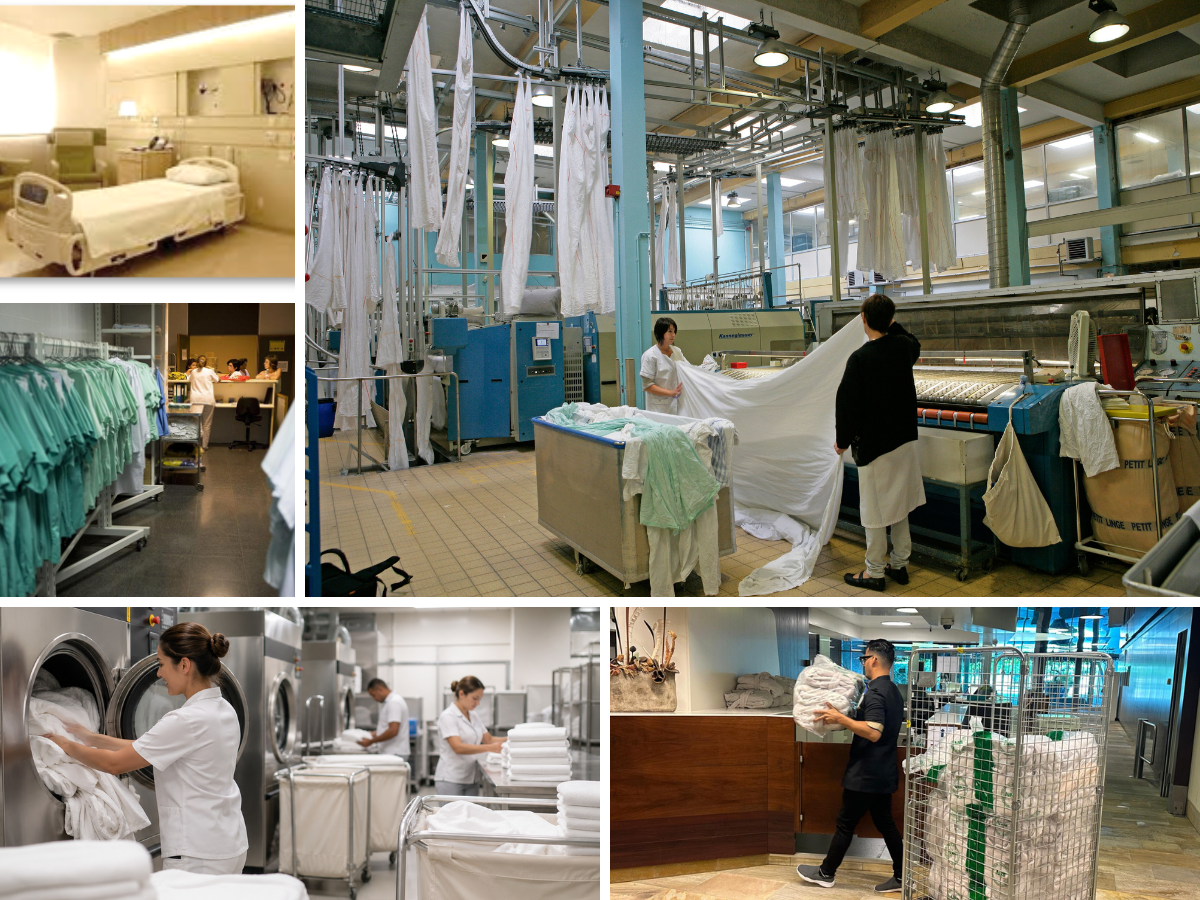
Industrial laundries and textile rental companies.
Multi-client operations where billing accuracy, loss prevention and client reporting are business-critical. See RFID for textile rental companies.
Hospitals and healthcare laundries.
Hygiene compliance, wash count documentation and sterilization tracking. See healthcare linen and garment tracking.
Hotels and hospitality laundries.
Linen loss reduction, inventory control and laundry-hotel interface reconciliation. See hotel linen tracking.

Workwear and uniform programs.
Garment assignment per employee, automated dispensing, PPE compliance. See workwear and uniform tracking.

Flat linen operations.
High-throughput sheet and towel processing with tunnel and portal integration. See RFID flat linen tracking.
For the full portfolio of solutions by sector and textile type, see RFID solutions specialized for any laundry sector and textile. For the broader context of RFID across the full textile lifecycle, see RFID textile tracking.
QUESTIONS & ANSWERS
Frequently asked questions
An RFID laundry management system is the connected infrastructure that uses RFID technology to identify, count, track and manage textile items throughout an industrial laundry operation. It combines RFID laundry tags, reading systems, device monitoring and software integration so every item can be followed from intake to dispatch and return. Each textile carries a LaundryChip™ with a unique identity, while readers capture movements automatically at key process points. The RFID data is then delivered to laundry management, ERP, billing or reporting software, enabling automated counting, real-time inventory, wash-count tracking, accurate billing and lifecycle visibility without manual scanning.
The difference between RFID laundry tracking and an RFID laundry management system is the scope of the solution. RFID laundry tracking is the data capture layer: tags, readers and item-level identification across the laundry process. An RFID laundry management system is the broader architecture that uses this data to manage inventory, client workflows, production planning, billing, reporting and ERP integration. In simple terms, RFID laundry tracking creates the item-level data, while the RFID laundry management system turns that data into operational control across the laundry’s existing software environment.
Datamars does not provide the full laundry management software used for production planning, order management, driver management, client billing or operational reporting. Datamars provides the RFID infrastructure layer, including LaundryChips™, RFID reading systems, Storm for device monitoring and Cloudburst for RFID data integration. The operational management software is provided through Datamars’ wide and proven network of laundry management RFID software partners. This open architecture allows laundries to keep their existing management platform and enrich it with RFID data, instead of replacing software that already supports their daily operation.
Cloudburst is the Datamars RFID data integration layer used in an RFID laundry management system. It collects RFID read data from Datamars reading systems and delivers it in a standardized, ready-to-use format to third-party laundry management software, ERP systems, billing platforms, client portals or analytics tools. Cloudburst acts as the bridge between the RFID hardware layer and the laundry’s operational software. This makes RFID data available for real-time inventory, wash-count tracking, billing feeds, client reporting and lifecycle analytics, while reducing the need for complex custom integration on the laundry side.
Storm is the Datamars RFID device monitoring and management platform used to keep the RFID laundry system reliable. In a laundry operation, if a reader goes offline, loses performance or is incorrectly configured, data gaps can appear before staff notice the issue. Storm monitors RFID readers and infrastructure across the installation in real time, detects anomalies, supports remote configuration management and gives a centralized view of the reading network. For large laundries, textile rental operations and multi-site installations, Storm helps protect the quality and continuity of the RFID data layer.
RFID laundry management system implementation depends on the size of the laundry, the number of reading points, textile volumes, software integration scope and whether the project covers one site or multiple sites. A focused single-site deployment with limited integration can usually be implemented faster than a complex multi-site architecture connected to ERP, billing and client reporting workflows. The implementation process normally includes system assessment, tag selection, reader infrastructure design, Cloudburst integration, Storm deployment, go-live and optimization. Datamars supports this process from initial assessment through installation, commissioning and post-deployment performance tuning.
The total cost of ownership of an RFID laundry system depends on tag volumes, reading infrastructure, installation complexity, software integration requirements and ongoing operational needs. The cost is not only the price of tags and readers: it also includes deployment, data integration, monitoring, maintenance and process change. Datamars’ open architecture can help reduce total cost of ownership because Cloudburst connects RFID data to existing management software instead of requiring a proprietary platform replacement. The business value comes from reduced manual counting, fewer losses, more accurate billing, better lifecycle planning and lower reconciliation effort.
An RFID laundry management system can integrate with existing ERP, billing, laundry management and reporting software through Cloudburst. Cloudburst is designed to collect RFID read data from Datamars reading systems and deliver it in standardized formats to third-party platforms. This allows laundries to connect RFID data to the software they already use for client accounts, billing workflows, inventory dashboards, production reporting or ERP processes. The goal is to add RFID laundry data management to the existing software environment, rather than forcing the laundry to replace operational systems that are already working.
An RFID laundry management system can support multiple laundry sites when the architecture is designed with centralized device monitoring and data integration. Storm provides centralized visibility over RFID readers and infrastructure across different sites, helping teams monitor device status, performance and configuration remotely. Cloudburst collects RFID read data from installed reading points and delivers it to the central management platform or connected third-party systems. This architecture is suitable for laundry groups, textile rental companies and multi-site operations that need consistent data across several facilities, customer locations, depots or countries.
The difference between an RFID laundry management system and RFID textile tracking is the level of lifecycle coverage. An RFID laundry management system focuses on the operational management of the laundry process: intake, sorting, washing, finishing, dispatch, inventory, billing and reporting. RFID textile tracking is broader because it follows reusable textiles across their full lifecycle, from production and first use through service, washing, maintenance, end-of-life and recycling. The laundry management system is one operational stage within the wider textile tracking lifecycle. Twinify supports full textile lifecycle visibility.
An RFID laundry management system is especially suited to UHF RFID technology, because UHF enables fast bulk reading of many textile items at the same time, at long range and without line-of-sight. This is essential in industrial laundry environments where garments, linen and reusable textiles move in bags, trolleys, carts, stacks or batches. Datamars LaundryChips™ and reading systems are based on UHF RFID, supporting high-throughput workflows such as intake, dispatch, cabinet reading, portals and tunnel systems. For a full explanation of the technology, see UHF RFID for textile services.
GET STARTED
Ready to assess your system requirements?
Tell us about your operation: laundry type, textile volumes, number of clients, existing management software and integration requirements. We will design the right rfid laundry management system architecture for your process and help you define the implementation path.
 Datamars | Textile ID