
RFID flat linen tracking
Track thousands of sheets, duvet covers, pillowcases, tablecloths and napkins automatically, with no manual counting.
RFID flat linen tracking allows industrial laundries, hotels, healthcare laundries and textile rental providers to identify, count and monitor high volumes of flat linen automatically throughout the laundry process. Each sheet, duvet cover, pillowcase, tablecloth, napkin or similar item carries a washable RFID linen tag — the LaundryChip™ — permanently embedded in the textile.
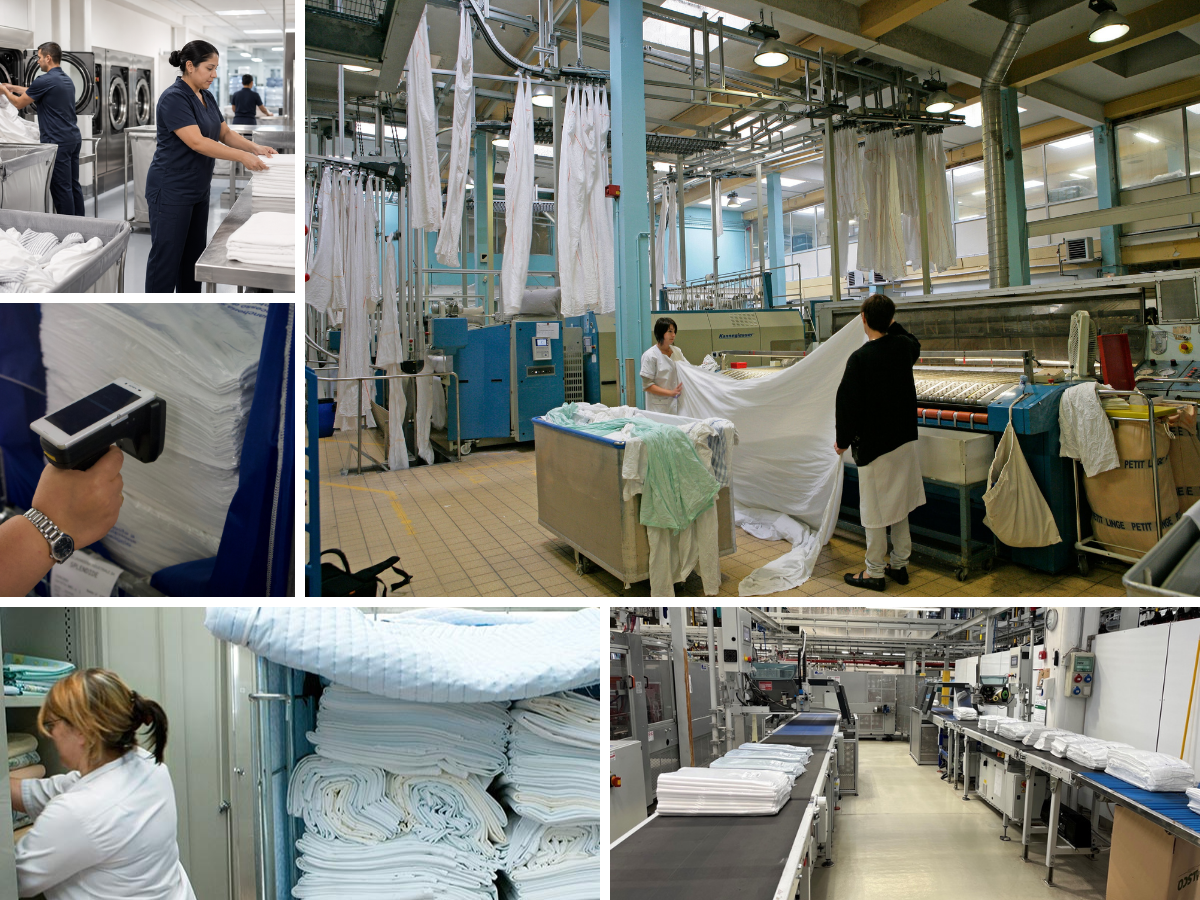
Flat linen operates at a different scale and speed from garments or workwear. A single laundry shift can process thousands of items across multiple clients, moving in bulk through tunnel washers, calenders, folders, sorting systems, storage areas and dispatch points. At this volume, manual counting is not viable and item-level traceability is impossible without RFID.
With UHF RFID flat linen tracking, every item is read automatically in bulk, without line-of-sight and without manual handling. Pass-through portals, cabinets and tunnel readers can capture up to 1,000 items in 3 seconds, allowing the system to count while the laundry line keeps running.
The result is real-time traceability of every flat linen item in circulation: what arrived, what was processed, what was dispatched, which client it belongs to, how many times it has been washed and whether it is missing. RFID flat linen tracking supports automated counting, accurate wash-count records, client-level reconciliation, delivery verification and transparent billing.
SYSTEM OVERVIEW
Key components
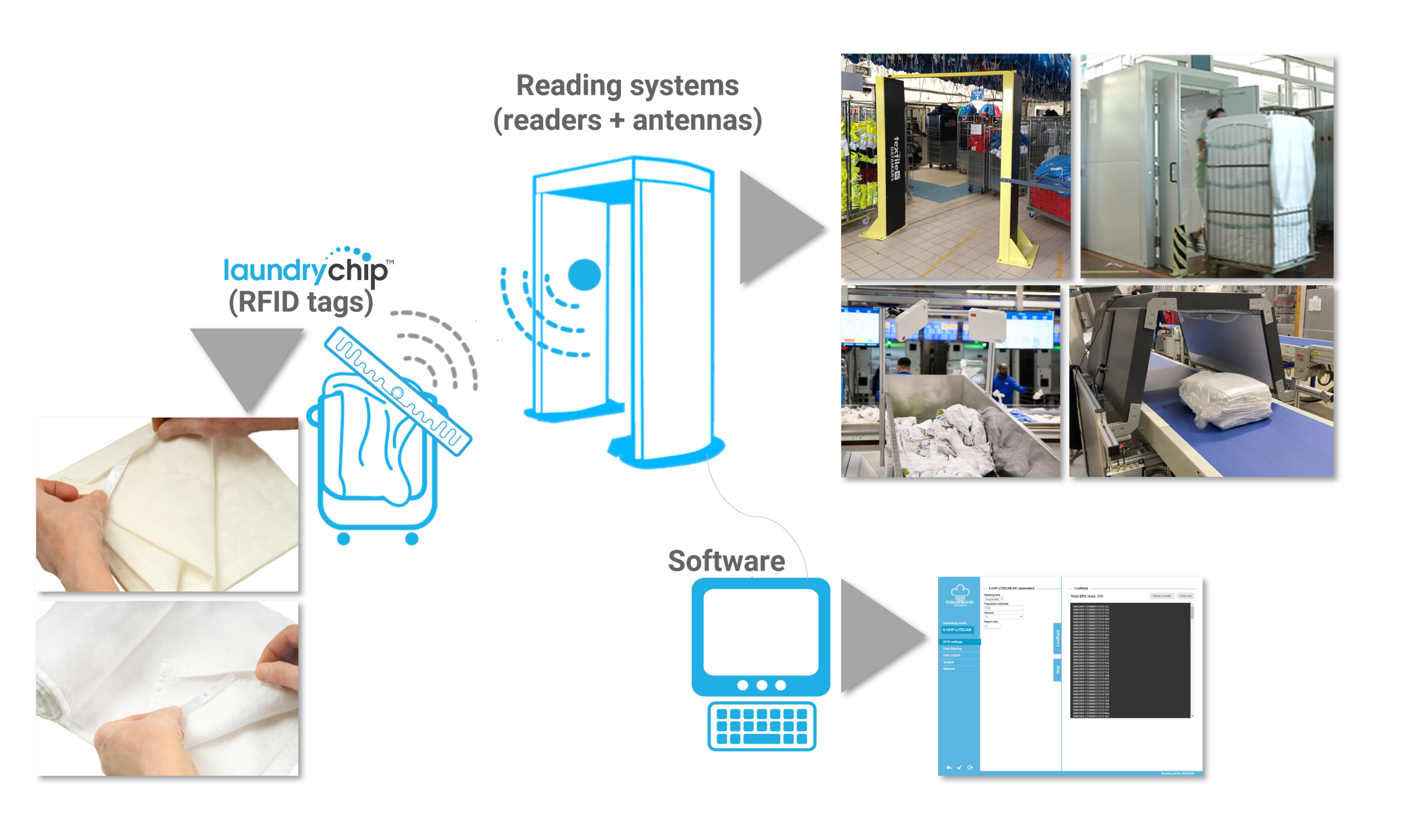
A complete RFID flat linen tracking system combines three connected core elements: RFID linen tags, RFID reading systems and software integration. The tag gives each flat linen item a unique digital identity, the readers capture items automatically in bulk at key process points, and the software turns every read into usable data for inventory visibility, client attribution, wash-count tracking, delivery verification, billing and loss control.
RFID linen tags
The LaundryChip™ FT401 (70 x 10 mm) is the standard tag for flat linen. The FT403 (37 x 15 mm) is the format for smaller items: napkins, facecloths, small towels where hem space is limited. Both are available in multiple application methods: sewn into the textile hem, heat-sealed directly onto the fabric, or pre-inserted into a sewable textile pouch. Both use the patented double loop antenna for consistent reading performance after hundreds of wash cycles. Both withstand high-temperature washing, chemical detergents, water extraction up to 60 bar, calender ironing and folding.The LaundryChip™ 40x and 50x families are OEKO-TEX Standard 100 certified.
RFID reading systems
Purpose-built hardware integrates into the flat linen process flow at key points:
- Pass-through portals at intake and dispatch: capture incoming and outgoing batches automatically. What arrived, from which client, in what quantity. What left, to which client, in what quantity. Discrepancies flagged before the truck moves.
- Tunnel systems integrated into sorting and finishing lines: read items as they move through the line at production speed. No interruption to the workflow.
- Cabinet systems: up to 1,000 items read in 3 seconds for bulk counting at transfer points or storage areas.
- Handheld devices: spot checks, reconciliation tasks, floor-level verification.
- Combo systems (UHF-HF-LF): for operations transitioning from older LF or HF infrastructure, allowing phased migration without replacing existing equipment.

Software
Datamars provides two software layers that ensure the system runs reliably and that data reaches the right place. Storm monitors and manages all RFID devices across the installation, keeping reading infrastructure reliable and under control. Cloudburst collects RFID read data and delivers it ready-to-use to third-party RFID linen management and laundry management software. Datamars relies on a wide and proven network of tracking software partners for the operational management layer.
PROCESS FLOW
How RFID flat linen tracking works in practice
RFID flat linen tracking follows each item through the full industrial laundry cycle: intake, sorting, washing, finishing, storage, dispatch, delivery and return. At every checkpoint, RFID readers capture item-level data automatically, without unpacking batches, separating textiles or counting manually. This gives operators a live view of item flow, stock levels, client allocation, wash count and missing items across all clients and textile categories.

Intake and check-in
Soiled items arrive from the client. A pass-through portal at the intake point captures the incoming batch: item count, client attribution, item identity. No unpacking. No manual counting. Discrepancies against the expected delivery are flagged immediately.

Sorting
Items move to the sorting area. RFID readers integrated into the sorting line identify each item by type and client. Automated sorting reduces manual handling and misallocation errors.

Washing and finishing
Tags remain attached through the full wash and finishing cycle. They withstand tunnel washer temperatures, extraction pressure, calender ironing and folding. After finishing, a reading point confirms processing and updates the wash count for each individual item.

Storage and dispatch
Clean linen moves to the storage area. Cabinet systems or portal readers confirm stock levels per client. At dispatch, the outgoing batch is verified: correct items, correct quantities, correct client allocation. Discrepancies are resolved before the truck leaves.

Delivery and return
At the client site, reading points confirm delivery and log returns, closing the loop on the full flat linen cycle.
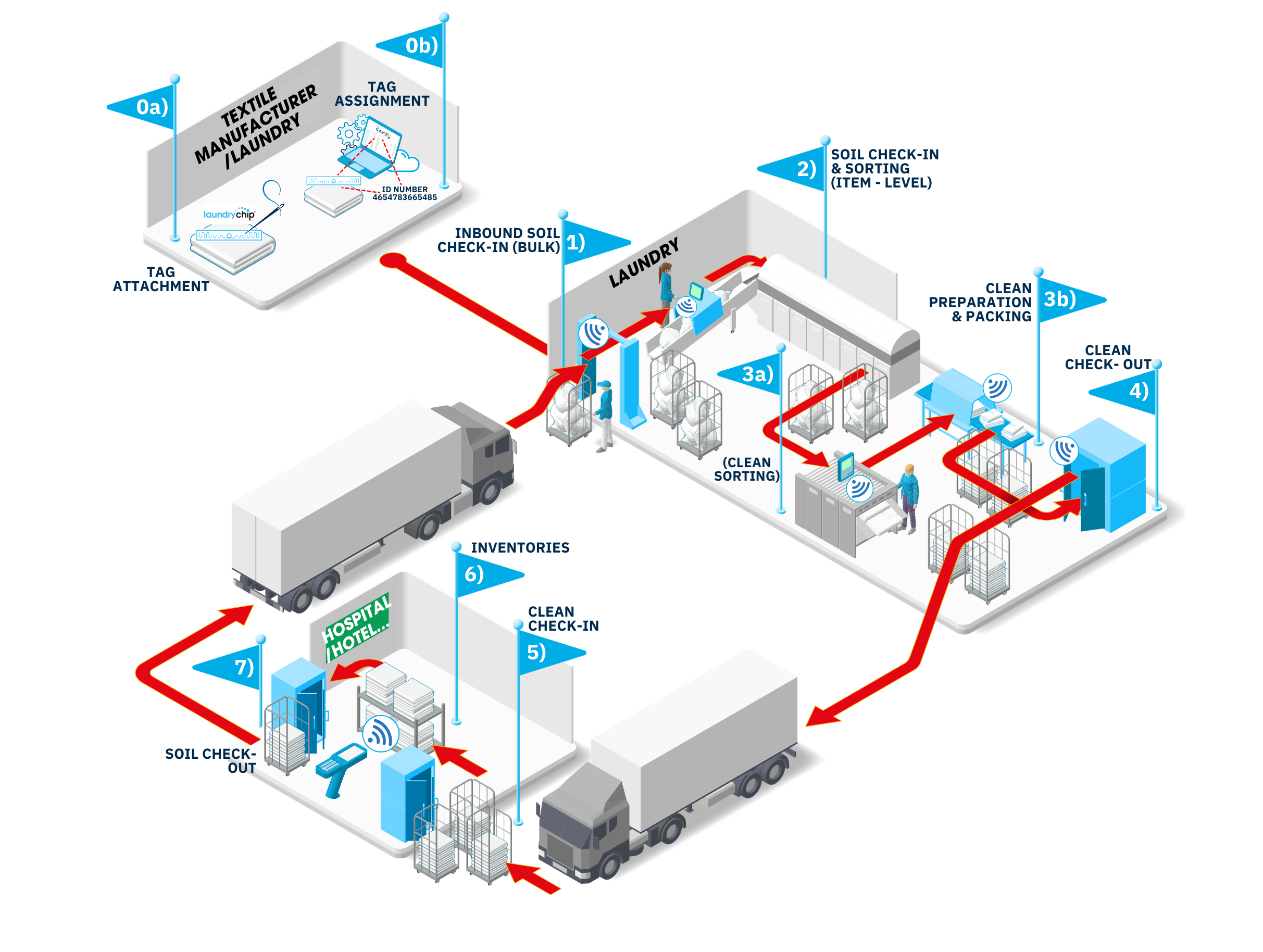
At every stage, operators see live inventory, item flow and wash count data on a single dashboard, across all clients simultaneously.
OPERATIONAL GAINS
Key benefits
The main benefits of RFID flat linen tracking are bulk reading, real-time inventory visibility, accurate wash-count records, client-level reconciliation, linen loss reduction, integration with sorting and finishing lines, and scalability across single-site or multi-site laundry networks. By automating item identification at industrial speed, RFID helps laundries process flat linen faster, reduce manual work and replace estimated counts with verified item-level data.
Bulk reading flat linen RFID
Up to 1,000 items in 3 seconds with the RFID pass-through system flat linen. No manual handling required.

Real-time inventory visibility
Know exactly how many items are in the laundry, at each client site, in transit or missing, at any moment, pinpointing exactly where losses occur.
Accurate wash count per item
Replace flat linen at the right time, based on actual lifecycle data. The RFID pass-through flat linen system records every wash cycle per individual item.

Client-level reconciliation
Item-level data per client eliminates billing disputes and supports transparent reporting. Every delivery and return is verified and recorded.
Integration with finishing and sorting lines
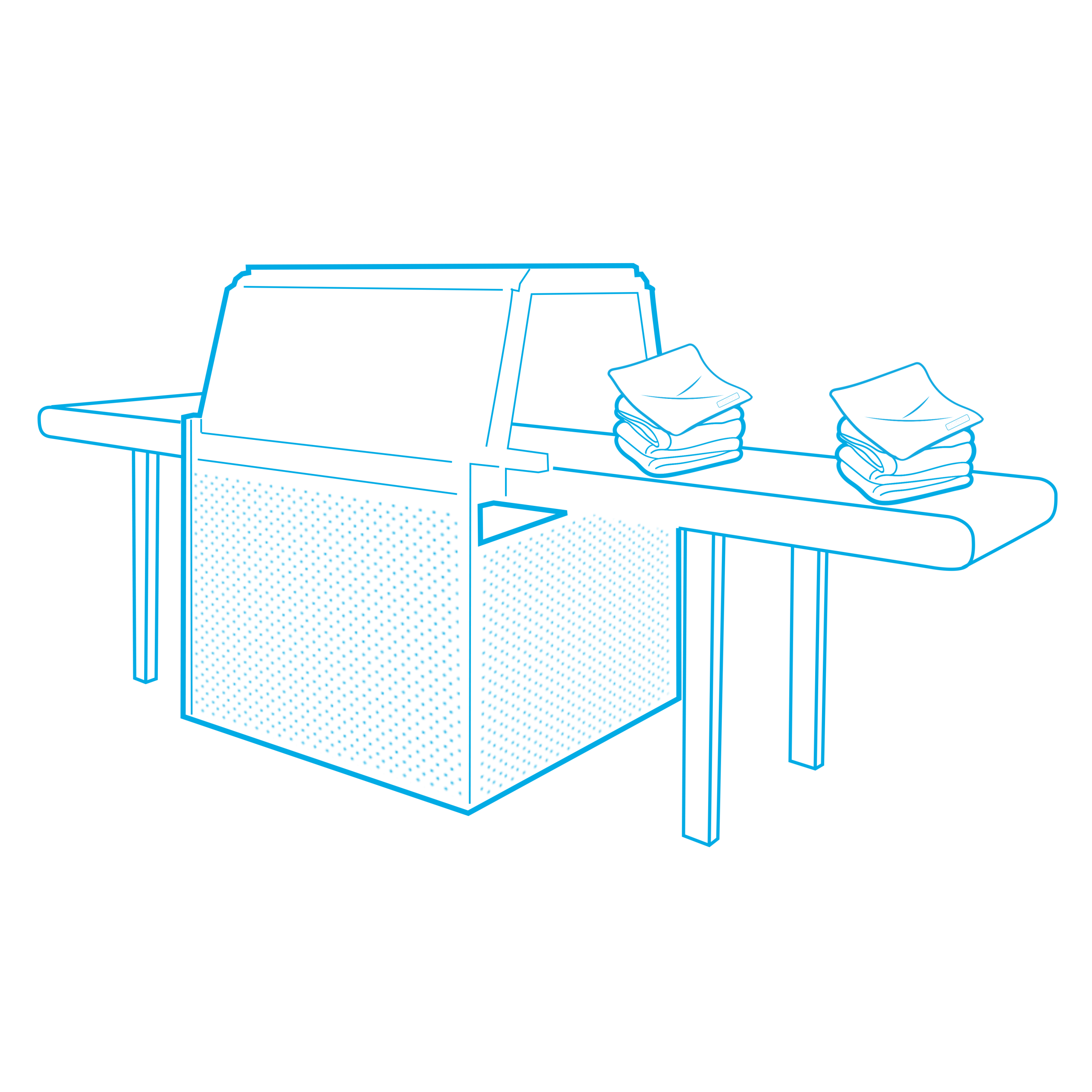
Reading systems integrate directly into calender lines, folding machines and sorting conveyors. The system counts while the line runs.
Scalability
The same architecture scales from single-site operations to multi-site laundry networks with centralized reporting.
DEPLOYMENT SCENARIOS
Common applications
RFID flat linen tracking is used wherever flat linen is processed at high volume:
- Industrial laundries. Multi-client operations processing hotel linen, healthcare linen and restaurant linen simultaneously. Focus on client-level accuracy, billing precision and loss attribution. See RFID laundry tracking.
- Hotel in-house laundries. Bed linen, towels, table linen and napkins. Focus on inventory control across the hotel-laundry interface and linen loss reduction. See hotel linen tracking.
- Healthcare laundries. Patient linen and flat surgical textiles. Focus on wash count compliance, hygiene traceability and MRI-safe tagging for items processed in clinical environments. See healthcare linen and garment tracking.
- Textile rental companies. Flat linen tracked per client contract, with item-level billing, lifecycle management and loss attribution across large rental inventories. See RFID textile rental tracking.
- Workwear operations with flat linen components. Operations that process both garments and flat linen within the same laundry can run both textile types on the same RFID infrastructure. See workwear and uniform tracking.
For the full portfolio of solutions by sector, role and textile type, see our RFID solutions specialized for any laundry sector and textile. For the broader context of RFID linen tracking technology across the full textile lifecycle, see RFID textile tracking.
See RFID flat linen tracking in action:
QUESTIONS & ANSWERS
Frequently asked questions
RFID flat linen tracking is the use of washable UHF RFID tags embedded in flat linen items to identify, count and monitor each textile automatically throughout the industrial laundry process. Sheets, duvet covers, pillowcases, tablecloths, napkins and similar items carry a LaundryChip™ with a unique digital identity. RFID readers capture the items in bulk at intake, sorting, washing, finishing, dispatch and delivery points, without manual handling and without line-of-sight. The core advantage is high-speed bulk reading — up to 1,000 items in 3 seconds — which makes item-level tracking viable even in high-throughput flat linen operations.
The best RFID linen tag for flat linen is usually the LaundryChip™ FT401, measuring 70 x 10 mm, because it fits into narrow hems, remains invisible once embedded and delivers reliable reading performance across the textile lifetime. For smaller flat linen items, such as napkins, facecloths or small towels, the LaundryChip™ FT403, measuring 37 x 15 mm, is the preferred compact format where hem space is limited. Both are UHF LaundryChips™ and use the patented double loop antenna for consistent bulk-reading performance. See RFID laundry tags for the complete selection guide.
An RFID pass-through system for flat linen is a portal reader installed at a defined process point, such as intake, dispatch, linen room entry, linen room exit or transfer between production areas. As carts, bags, stacks or batches of tagged flat linen pass through the portal, the system reads all RFID tags simultaneously, without separating items and without line-of-sight. Each read event is logged with timestamp, item identity, quantity and client attribution. This allows laundries to verify what arrived, what left, which client it belongs to and whether there are discrepancies against expected delivery or return data. Please see the UHF PORTAL 201 and the UHF PORTAL PLUS.
RFID can read flat linen items at industrial speed when UHF readers are used with the correct tag format and system configuration. Cabinet systems and pass-through portals can read up to 1,000 items in 3 seconds, while tunnel systems integrated into finishing or sorting lines can read items at production speed without interrupting the workflow. This bulk reading flat linen RFID capability is what makes the technology operationally viable for laundries processing thousands of sheets, duvet covers, pillowcases, tablecloths and napkins per shift. The system counts automatically while the laundry process continues to run.
RFID tags for flat linen must survive the specific mechanical and thermal stress of high-volume linen processing, including water extraction, tunnel washing, calender ironing and folding. LaundryChips™ are engineered for industrial laundry environments and are designed to withstand high-temperature washing, chemical detergents, high-pressure water extraction up to 60 bar, calender ironing and folding machines. The tag remains attached and readable across the textile lifetime when the correct format and application method are used. This durability is essential for flat linen operations, where a tag failure would create data gaps, manual rework and unreliable lifecycle records.
The difference between RFID flat linen tracking and RFID laundry tracking is mainly the scope of application. RFID laundry tracking covers the full laundry operation across different textile types, including garments, workwear, flat linen, towels, uniforms and rental textiles. RFID flat linen tracking is the specific application for high-volume flat linen items such as sheets, duvet covers, pillowcases, tablecloths and napkins. It uses tag formats, reading points and system layouts optimized for bulk movement, pass-through reading, tunnel systems, calender lines, folding machines and client-level reconciliation in flat linen workflows.
RFID for flat linen management means using item-level RFID identification to manage flat linen inventory, client attribution, wash counts, deliveries, returns and losses across the full laundry cycle. Each item carries a LaundryChip™ and is read automatically at defined checkpoints. The RFID read data flows through Cloudburst into the laundry’s management software, where operators can see real-time dashboards, client-specific inventory, wash-count records, delivery verification and discrepancy alerts. This creates a reliable RFID linen management layer that replaces manual counting, improves reporting and supports lifecycle-based replacement planning for sheets, duvet covers, pillowcases, tablecloths and napkins.
RFID can track sheets, towels, tablecloths and other linen items simultaneously within the same system. Each item type carries the appropriate LaundryChip™ format, and all tagged items can be read by the same RFID infrastructure. The software associates each unique tag ID with the correct textile type, client, location, wash count and lifecycle record. This means sheets, duvet covers, pillowcases, table linen, napkins, towels and similar items can move through the same laundry process while remaining individually identifiable. Tracking multiple textile categories together helps laundries manage mixed batches, client allocation and inventory reporting without manual separation.
RFID flat linen tracking is especially suitable for multi-client laundry operations because every item is identified individually and linked to a specific client, contract or account. Intake, sorting, washing, finishing, storage and dispatch can be tracked per client and per item, even when multiple customer batches move through the laundry on the same day. This supports accurate delivery verification, transparent billing, loss attribution and client-level wash-count reporting. For laundries processing hotel linen, healthcare linen, restaurant linen or rental flat linen for many customers, RFID replaces estimated reconciliation with reliable item-level data for each client account.
The difference between RFID flat linen tracking and an RFID laundry management system is that flat linen tracking is the RFID data capture layer, while the laundry management system is the broader operational platform. RFID flat linen tracking includes the tags, readers and item-level identification used to capture data from sheets, duvet covers, pillowcases, tablecloths and napkins. The RFID laundry management system uses that data to manage inventory, client workflows, production planning, reporting, billing and ERP integration. Datamars provides the RFID infrastructure and Cloudburst integration, while management software is provided through Datamars’ tracking software partners.
RFID flat linen tracking supports hotel linen operations by giving hotels and their laundry partners item-level visibility over sheets, pillowcases, duvet covers, towels, table linen, napkins, robes and similar textile assets. In hotel environments, RFID helps verify deliveries and returns, reduce linen losses, monitor wash counts, improve inventory accuracy and reduce disputes between the hotel and the laundry provider. For hotels with in-house laundries, the same system can support the full linen cycle inside the property. For hotel-specific context, including tracking across the hotel-laundry interface and linen loss reduction, see hotel linen tracking.
RFID flat linen tracking is one application within the broader field of RFID textile tracking. Flat linen tracking focuses on high-volume items such as sheets, duvet covers, pillowcases, tablecloths and napkins as they move through the laundry cycle. RFID textile tracking is wider because it follows reusable textiles across their full lifecycle, from production and first use through washing, service, maintenance, end-of-life and recycling. The Datamars Twinify platform is designed to support full textile lifecycle visibility by linking each physical textile identity to a digital record.
An RFID flat linen tracking system can integrate with existing sorting lines, conveyor systems, calender feeding stations, folding machines and finishing lines. The integration approach depends on the laundry layout, line speed, textile flow, available space and required reading points. RFID readers can be installed as pass-through portals, tunnel systems, cabinet systems or line-integrated reading points, depending on where item identification is needed. Datamars supports system assessment, integration design and installation planning to make sure the RFID infrastructure fits the existing process without slowing down production. The goal is to count and identify items while the line keeps running.
GET STARTED
Ready to assess your flat linen operation?
Tell us about your operation: daily volume, number of clients, current reading infrastructure and the flat linen types you process. We will design the right rfid linen tracking system configuration for your throughput and integration requirements.
 Datamars | Textile ID